304 vs 316 Stainless for Coastal & Outdoor Kitchens
- Share
- publisher
- Samsink Engineering Team
- Issue Time
- Nov 25,2026
Summary
Salt decides which stainless grade belongs in an outdoor kitchen. This guide compares 304 and 316 chemistry and PREN, explains where 304 is genuinely adequate outdoors, when 316L pays back its 25-40% premium, why marine grade is a marketing phrase, and which drainage, weld, gauge, finish and maintenance details decide whether either alloy survives a coastal site.
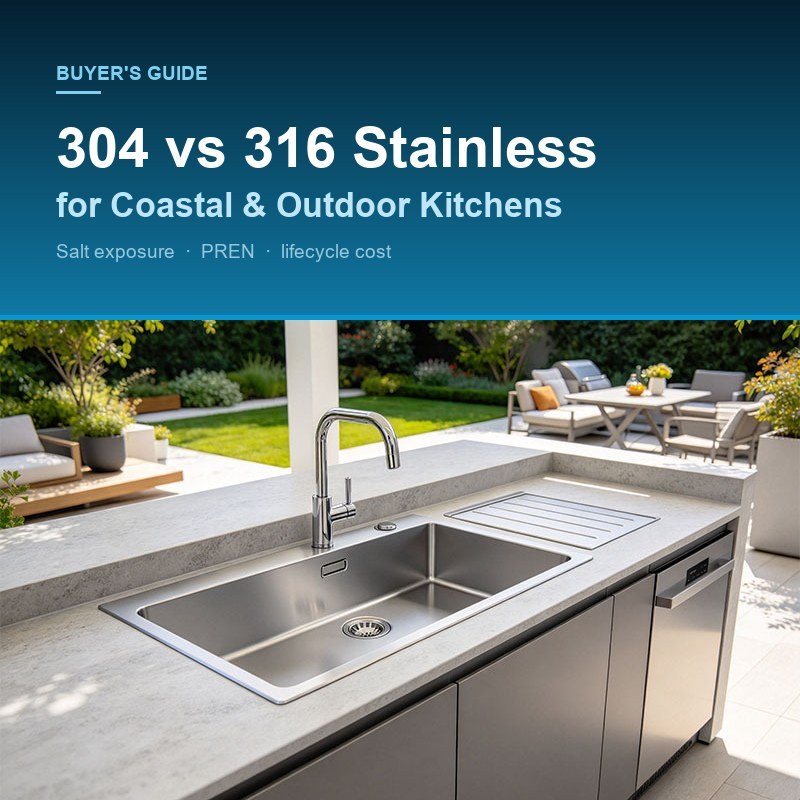
A sink on a covered inland patio and a sink ten minutes from open water are the same part number and two completely different engineering problems. Salt turns the question from “will it hold up?” into “which alloy, detailed which way, still looks acceptable in year eight?”
This guide is written for the people who actually specify the sink: fabricators, distributors, hospitality project buyers, landscape and outdoor-kitchen contractors, and homeowners signing off a drawing with their builder. It covers the chemistry that decides corrosion performance, the honest limits of 304 outdoors, when 316 earns its price, and the build and maintenance details that decide the outcome regardless of grade.
Short answer
- 304 is a real outdoor grade and the default for covered, inland outdoor kitchens with low chloride load and routine cleaning.
- 316 adds 2–3% molybdenum (PREN roughly 25 versus 18–20), which is the only material difference that matters in salt air. Within about 5–10 miles of the coast, beside a saltwater pool, or on an exposed deck, specify 316 or 316L.
- Neither grade survives bad detailing. Standing water, untreated weld heat tint, trapped salt under a grid, and chlorinated cleaners pit a 316 bowl too.
304 vs 316 stainless steel for outdoor use: the 30-second answer
304 is an 18/8 austenitic stainless steel: roughly 18–20% chromium, 8–10.5% nickel, no molybdenum. 316 keeps 16–18% chromium, raises nickel to 10–14%, and adds 2–3% molybdenum. Both rely on the same protective mechanism — a self-repairing chromium-oxide film a few nanometres thick. The difference is how well that film resists being broken down locally by chloride ions.
That single addition is the whole argument. Outdoors, corrosion is rarely a uniform “the whole sheet rusts” event. It is a local breakdown at one point: a pit at the drain, a line of corrosion along a weld, a rust bloom under the rim where oxygen cannot refresh. Molybdenum raises the chloride concentration needed to start that breakdown, which is exactly the failure mode that shortens the life of an outdoor sink.
What 304 and 316 do not differ in: annealed yield strength (about 205–215 MPa for both), magnetism, heat tolerance, or formability in any way that changes a sink. If a supplier is selling 316 on strength, they are selling the wrong property.
What actually separates 304 from 316
| Property | 304 | 316 | 316L |
|---|---|---|---|
| Common designations | UNS S30400, EN 1.4301 | UNS S31600, EN 1.4401 | UNS S31603, EN 1.4404 |
| Chromium | 18–20% | 16–18% | 16–18% |
| Nickel | 8–10.5% | 10–14% | 10–14% |
| Molybdenum | — | 2–3% | 2–3% |
| Carbon (max) | 0.08% | 0.08% | 0.03% |
| PREN (typical) | 18–20 | 24–26 | 24–26 |
| Relative sheet cost | 1.0 (baseline) | 1.2–1.5× | 1.2–1.5× |
| Best fit | Inland, covered, low-chloride | Coastal, poolside, salt exposure | Welded coastal fabrication |
PREN: the one number worth comparing
Pitting Resistance Equivalent Number is the standard way to put a figure on chloride resistance: PREN = %Cr + 3.3 × %Mo + 16 × %N. 304 lands around 18–20. 316 and 316L land around 24–26. Duplex 2205, the grade used for splash zones and immersed saltwater hardware, sits near 34–36.
The reference points that matter for a sink: marine atmospheric exposure (ISO 9223 category C5-M) generally wants PREN of 25 or more, which 316 meets and 304 does not. Continuous seawater immersion wants 40 or more, which neither meets — that is duplex territory. A sink bowl is neither immersed nor in the splash zone, so 316L is normally the sensible ceiling for outdoor kitchens.
What published salt-spray hours do and do not tell you
ASTM B117 neutral salt fog results for these grades are often quoted as roughly 200–700 hours to first corrosion for 304 and 1,500–1,800 hours or more for 316. Treat those as a direction, not a lifespan. B117 is a comparative laboratory test run at a fixed salt concentration and temperature; nobody's patio is a continuous 5% sodium chloride fog at 35°C. Results also move substantially with surface finish, passivation state, sample preparation and what the lab counts as failure.
So when a supplier quotes a salt-spray number, the useful questions are: which standard, how many hours, and what was the pass/fail criterion? A number without those three is decoration. Our earlier 304 vs 316 comparison for outdoor sinks covers the same chemistry from a product-selection angle if you want a second pass at it.
Is 304 stainless steel good for outdoor use?
Yes. 304 is a legitimate outdoor grade, and it is what the majority of outdoor kitchen sinks sold in North America and Europe are made from. The honest qualifier is not “outdoor” but which outdoor. Here is the line we would draw in a quotation review.
304 is usually the right call when
- The sink sits under a roof, pergola or in a screened enclosure.
- The site is more than 10–15 miles from open coast with no visible salt film.
- There is no saltwater pool, spa, or winter de-icing salt on the surrounding paving.
- The household rinses and wipes the bowl as part of normal use.
- The sink is top-mount or freestanding, where replacement later is straightforward.
304 becomes the wrong call when
- The site is within a few miles of surf and onshore wind.
- The sink is sheltered from rain but exposed to salt-laden air — a lanai or screened porch.
- A saltwater pool is within splash or overflow distance.
- The bowl sees daily brine, seafood prep, or salted food residue.
- It is a visible feature where brown tea staining would be rejected at handover.
The failure pattern is consistent and it is rarely structural at first. Year one or two brings tea staining — a brown surface film. Year three to five brings pitting around the drain or under the rim. A 304 bowl that pits in that service is not a defective sink; it is a correct alloy in the wrong exposure. If you are specifying the metal itself rather than the environment, our 304 stainless steel kitchen sink guide goes deeper into gauge and thickness selection.
How far from the sea does grade start to matter?
Distance is the question every buyer asks and the weakest single variable in the answer. It is still the most useful starting frame, so here is how we read it — then the caveat that matters more.
| Exposure band | Typical condition | Grade we would specify | Why |
|---|---|---|---|
| 0–1 mile, open surf | Salt deposits between rain events, constant onshore wind | 316L; duplex 2205 for anything in the splash zone | Chloride load is above the pitting threshold for 304 |
| 1–5 miles | Visible salt film after storms and onshore days | 316 / 316L | Field reports of 304 pitting in roughly three years at this exposure |
| 5–10 miles | Occasional salt, high humidity | 316 for exposed or uncovered; 304 acceptable if covered and cleaned | Borderline — the cost of being wrong is high |
| 10–15 miles | No visible salt, normal suburban air | 304, with routine cleaning | Chloride load is below the practical threshold |
| 15+ miles inland | No chloride source | 304 — spend the difference on gauge and finish | 316 buys a property the sink will never use |
The caveat: wind, surf, elevation, shelter, humidity and cleaning frequency matter more than miles. A covered sink 300 metres from the water can accumulate more salt than an uncovered sink three kilometres inland, because rain never washes the sheltered one. The better framework is ISO 9223 corrosivity: C2–C3 for ordinary inland atmosphere, C4 for coastal, C5 for severe marine, CX for extreme. 304 is a C2–C3 material in continuous chloride service; 316 is the C4 grade.
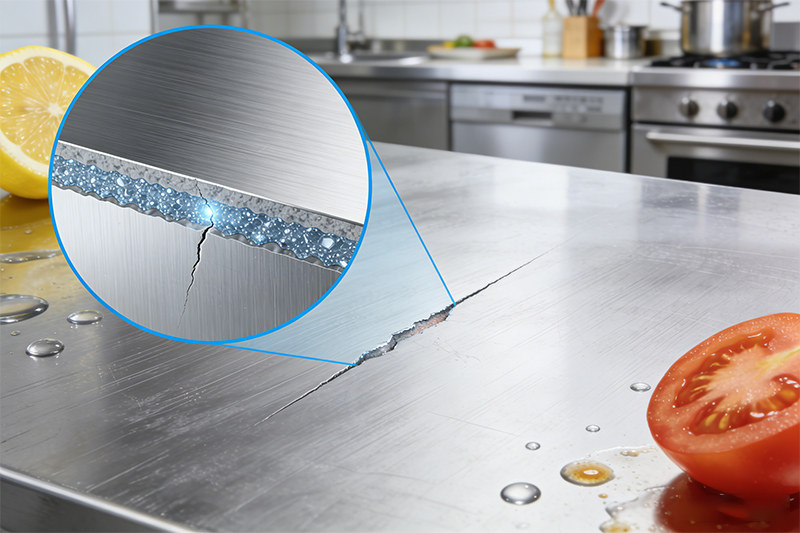
What salt actually does to a sink
Chloride attack on stainless steel takes three forms, and buyers routinely conflate them. They have very different consequences.
Tea staining
A brown surface discolouration, usually within 1–3 km of the coast. It is cosmetic — no meaningful metal loss — but it is a signal that salt is accumulating faster than it is being removed, and that finish or cleaning needs attention.
Pitting
A local breakdown of the passive film that creates small, deep cavities. The visible opening can be tiny compared with the depth, so it is easy to miss during routine cleaning. In an 18-gauge bowl, sustained pitting can perforate.
Crevice corrosion
The same mechanism, accelerated where oxygen cannot refresh: under the rim, behind sealant, between a sink and stone, under the rubber feet of a bottom grid. This is where most coastal 316 failures actually start.
In sinks, corrosion almost always begins in one of five places: the drain hole and its fitting, weld seams and heat tint, the rim or undermount joint, the feet of a bottom grid, and any spot where water stands after use. This is why a 316 bowl fitted with a plated zinc drain still rusts — at the drain, not in the bowl.
Is a “marine grade outdoor sink” a real specification?
No. “Marine grade” does not appear in ASTM A240, EN 10088 or any ISO standard for flat-rolled stainless. It is a trade phrase, and it means whatever the seller wants it to mean — listings exist that apply it to 304. If you need the term to carry legal weight in a purchase order, replace it with a grade and a standard: “316L per ASTM A240 / EN 1.4404, PREN ≥ 24, mill test certificate per heat.” That sentence is enforceable; “marine grade” is not.
Used honestly, the phrase maps to three different things depending on where the metal sits. 316/316L is the marine-atmosphere grade and the right one for a coastal outdoor kitchen. Duplex 2205 (PREN around 34) is the splash-zone and immersed grade, at roughly double the material cost and with stricter welding rules. Super duplex 2507 is for permanent seawater immersion. A kitchen sink is none of those last two, so 316L is normally the ceiling you need.
The one variant worth insisting on: specify 316L rather than plain 316 when the bowl is welded. The “L” caps carbon at 0.03% instead of 0.08%, which limits chromium carbide precipitation in the heat-affected zone — sensitisation — that would otherwise leave a narrow band of chromium-depleted steel beside every weld. For a drawn or pressed bowl with minimal welding, 316 and 316L perform alike; for fabricated bowls, 316L is the safer line on the drawing.
And the claim to reject outright: “316 never rusts.” It resists chlorides better and it is not immune. Warm, concentrated brine, chlorinated cleaner left to dwell, or a rough surface will pit 316 as well.
316 stainless steel outdoor sink: when the premium pays back
The cost delta is real and predictable. 316 sheet typically runs about 1.2–1.5× the price of 304, and a finished 316 sink usually lands 25–40% above the 304 equivalent. The question is not whether that is more money; it is whether you pay it once or twice.
| Scenario | 304 outcome | 316 outcome | What we would do |
|---|---|---|---|
| Covered inland patio, 20 miles from coast | Bright for a decade with normal cleaning | Indistinguishable from 304 in service | 304, and put the saving into 16-gauge and a better drain |
| Seafront terrace, 800 m from surf | Tea staining in year one, pitting likely by year three to five | Tea staining possible; pitting much less likely | 316L, plus monthly freshwater rinse |
| Undermount bowl in a stone island, salt air | Replacement means cutting or lifting the countertop | Premium paid once | 316L — the removal cost dominates the maths |
| Freestanding utility sink by a pool | Cheap to replace, but visible staining | Longer service life | 316 if appearance matters, 304 if it is a work sink |
The economic argument is strongest for undermount installations. A pitted 304 bowl under a stone worktop cannot simply be swapped: the countertop has to be cut or lifted, which usually costs more than the sink itself, and the stone may not survive the operation. In that configuration the 316 premium buys insurance on the most expensive part of the assembly. For a top-mount or freestanding sink, replacement is a morning's work, so 304 is a defensible choice even near the coast — if you accept the staining.
What a 316 stainless steel sink needs besides the alloy
Grade sets the ceiling. Detailing decides whether you get near it. These are the seven items we check on a coastal order before it leaves the line.
- Drainage with no standing water. Slope to the outlet, drain centred on the low point, no flat spots between pressing ribs. Salt concentrates wherever water evaporates.
- Generous radii and no tight crevices. R10 corners or larger; avoid lapped seams and folded joints that hold brine out of reach of a cloth.
- Weld treatment, not just welding. Heat tint is chromium-depleted and is the first place a fabricated bowl rusts. Pickle and passivate post-fabrication to ASTM A967, and mechanically remove heavy oxide before final passivation.
- No free iron anywhere on the surface. Dedicated stainless tooling, no carbon-steel wire wheels or brushes, no grinding sparks from nearby carbon steel settling on the bowl. Embedded iron particles rust and look exactly like a material failure.
- Matching wet-side components. 316 drain body, A4/316 fasteners to ISO 3506, stainless grid with feet that do not trap salt. The bowl is only as good as the cheapest part touching water.
- Isolation from dissimilar metals. Aluminium framing, galvanised studs and copper lines in contact with the bowl create galvanic couples. Use isolators or non-metallic interface washers.
- Sealant and rim detail on undermounts. A full bed with no void, correct backer, and a joint that can be inspected. A failed sealant line becomes a crevice that holds salt water indefinitely.
Finish selection belongs in the same conversation. Smoother, electropolished surfaces retain less salt and clean more easily; a deep brushed grain holds residue in the valleys. Powder coating is a legitimate option for coastal exteriors and cabinets — but every scratch exposes bare 304 underneath, so treat the coating as decoration, not as a corrosion barrier.
Gauge, finish and coating: what they change and what they don't
| Variable | What it changes | What it does not change |
|---|---|---|
| Gauge (16 ga / 1.5 mm vs 18 ga / 1.2 mm) | Dent resistance, rigidity, sound deadening, perceived quality | Corrosion initiation — that is chemistry, not thickness |
| Finish (2B, No.4 brushed, hairline, mirror, electropolished) | Salt retention, cleanability, fingerprint visibility, aesthetics | The alloy's pitting resistance in a given environment |
| PVD colour coating | Appearance and scratch visibility | Grade: a PVD 304 bowl is still 304 at every scratch and edge |
| Powder coat | Colour, and a physical barrier where intact | Underlying grade; a scratch re-exposes the substrate |
| Sound pads and undercoating | Noise and condensation | Corrosion — but check the adhesive edges, which can trap moisture |
Two myths worth retiring here. A magnet cannot tell 304 from 316: both are austenitic and effectively non-magnetic when annealed, and cold work makes either slightly magnetic. And a thicker bowl does not resist coastal rust better — gauge is a mechanical property, and specifying 14-gauge 304 in a salt-spray zone simply gives you a heavier bowl that pits.
Maintaining a coastal or outdoor sink
Most tea-staining complaints are a cleaning problem, not an alloy problem. The routine is short.
- After use: rinse with fresh water if the sink has held brine, seafood, citrus or salted food. Do not leave a wet sponge, cloth or metal can in the bowl.
- Weekly in a spray zone, monthly elsewhere: wipe with mild detergent and water, work along the grain, then dry. This is the single highest-value habit.
- Never leave chlorinated cleaner to dwell. Bleach, hydrochloric or muriatic acid, and many “mould and mildew” products attack the passive film directly. If used by mistake, rinse immediately and generously.
- No steel wool, no carbon-steel brushes. They deposit free iron, which then rusts and looks like a much worse problem than it is.
- Seasonally: remove the bottom grid and clean beneath its feet, check the rim joint and drain for salt crust, and wash down after storm season or any salt event.
- If a rust bloom appears: remove it early with a non-abrasive stainless cleaner or a dilute phosphoric-acid based product, rinse, and let the surface re-passivate in air. Persistent pitting is a different matter — that is metal loss and needs assessment, not cleaning.
The RFQ spec sheet for a coastal sink
This is the block we recommend pasting into a purchase order. It converts adjectives into inspection points, which is what protects both sides when the sink is installed two years later.
| Line item | What to write | Why it matters |
|---|---|---|
| Grade and standard | 316L per ASTM A240 (EN 1.4404) | Gives the mill a target, not an adjective |
| Certificate | Mill test certificate per heat, EN 10204 3.1 | Proves the sheet that arrived is the sheet ordered |
| Gauge | 16 ga / 1.5 mm bowl where dent resistance matters | Mechanical performance, not corrosion |
| Finish | No.4 brushed or electropolished; Ra value if specified | Salt retention and cleanability |
| Weld treatment | Pickled and passivated to ASTM A967 | Removes chromium-depleted heat tint |
| Drain and fasteners | 316 drain body, A4 fasteners to ISO 3506 | The wet-side parts fail first |
| Corrosion test | ASTM B117 hours and the acceptance criterion | Makes results comparable between suppliers |
| Accessories | Grid, strainer, sealant, isolators — all 316 | One 304 accessory undoes the bowl |
| Packaging | No mixed grades per carton; film removal instructions | Prevents site-level mix-ups and trapped moisture |
| Warranty | What is covered, and what voids it | Tea staining is usually excluded; pitting is usually not |
How Samsink builds outdoor and coastal sinks
Samsink has been manufacturing stainless steel sinks in Foshan since 1995, with a second production base in Bangkok. For outdoor and coastal projects the operationally useful fact is that 304 is the standard build and 316 sheet is available on request across our custom and semi-custom sink models — so the grade decision is a line on the quotation rather than a separate product family you have to source elsewhere.
On the production side, the checks that matter for salt exposure are the ones around material identity and surface condition: incoming sheet verified against the mill certificate, gauge checked per panel, seams dressed and passivated, drainage verified with a standing-water check, and finish inspected under raking light before packing. Selected kitchen sink models are cUPC and NSF listed. Minimum order quantities run from 20 pieces on some custom models to 500+ on fully tooled high-volume designs, with OEM and ODM both accepted.
If you want the production detail behind those claims, the factory, MOQ and QC walkthrough covers tooling cost, lead time and inspection stages; the OEM vs ODM process guide explains what happens between drawing and mass production. If your project is a commercial or hospitality fit-out, the installation and rough-in guide covers the site side.
Recommended models for outdoor and coastal kitchens
Four configurations cover most outdoor layouts. All four are built in 304 as standard; specify 316 or 316L on the RFQ where the exposure analysis above calls for it — the grade is a production option, not a different catalogue number.
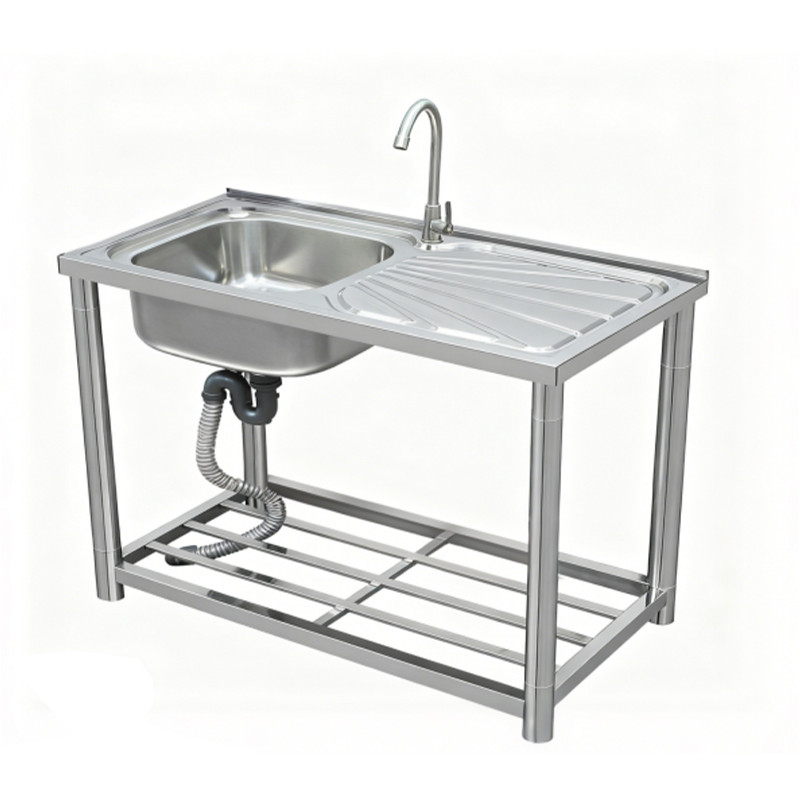 FR-DR1050-80
Freestanding work sink
Outdoor Utility Sink, Deep Single Bowl
Best for garden, poolside and service yards where the sink stands on its own and takes heavy use.
SUS 304Deep single bowlLegs + shelf
View specifications
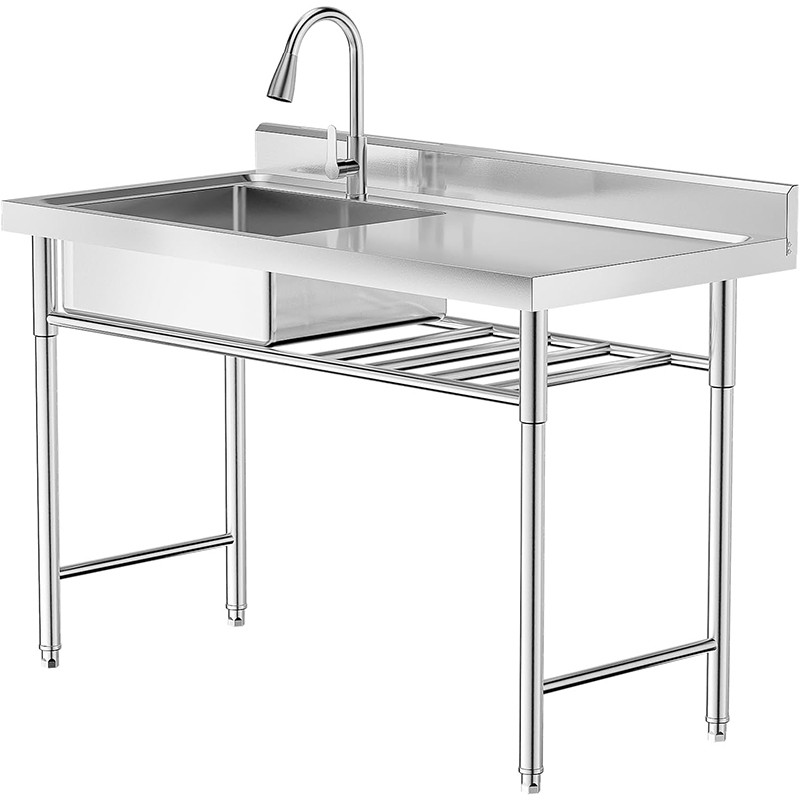 GA-7070
304 or 316
Garden Sink with Workbench
Best for outdoor prep zones that need a landing area beside the bowl, not just a basin.
304 / 316Workbench topMOQ 20 pcs
View specifications
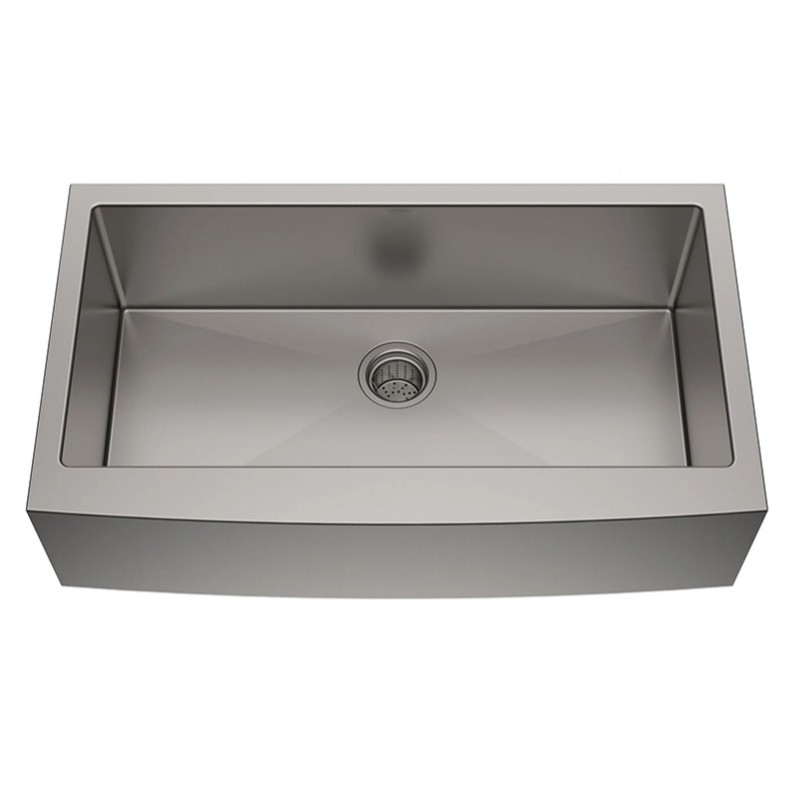 SM-3322-00
304 or 316
Apron Front Farmhouse Sink
Best for outdoor islands where the bowl is part of the facade and guests sit close to it.
304 / 316Brushed interiorApron front
View specifications
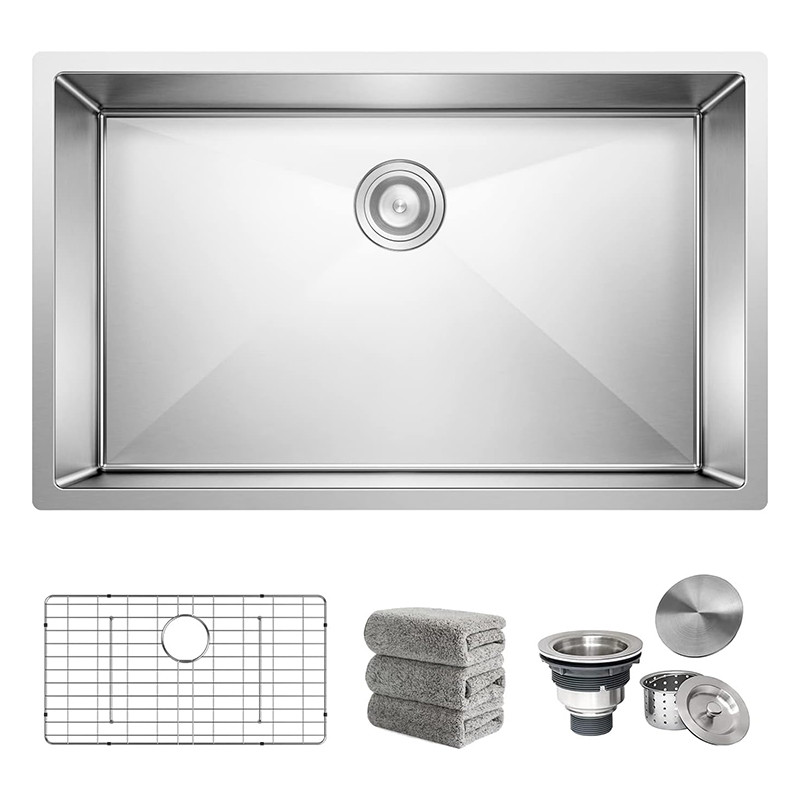 SM-URD30189-US
304 or 316
30" Undermount Sink, 16 Gauge
Best for stone worktops, where the bowl should sit flush and be replaced as rarely as possible.
304 / 31616 gaugeUndermount
View specifications
Grade, gauge and drain specification are fixed on the RFQ, not on the model number — each of these builds can ship in 304 as standard or 316 / 316L to the exposure analysis above.
Browsing by layout instead? The garden sink range covers outdoor and freestanding formats, while the undermount, farmhouse and top mount collections hold the models most often specified into outdoor islands. If your question is about thickness and dent resistance rather than grade, the utility sink material and gauge guide is the faster read, and the handmade sink guide covers 304 vs 316 alongside installation types.
Frequently asked questions
Can 316 stainless steel rust?
Yes. Salt buildup, a rough or contaminated surface, a crevice that holds moisture, and chlorinated cleaners can all stain or pit 316. The grade buys margin in chloride exposure; it does not buy immunity. What 316 changes is how much salt and how long a dwell it takes before local breakdown starts.
Does a magnet prove a sink is 316?
No. Both 304 and 316 are austenitic and effectively non-magnetic in the annealed condition, and cold working makes either slightly magnetic. A magnet cannot measure molybdenum, which is the only element that separates them. Ask for the mill test certificate per heat instead.
Is 304 acceptable in a covered coastal kitchen?
Often yes — but a covered sink is not a protected sink. Rain is blocked while salt-laden air still passes through, so deposits accumulate instead of being washed away. If you choose 304 in that position, deliberate freshwater rinsing on a weekly schedule is part of the specification, not an optional extra.
Is 18/8 the same as 304?
18/8 describes roughly 18% chromium and 8% nickel, which is the classic 304 composition. It is a trade description rather than a grade designation; two 18/8 sinks can differ in carbon, gauge and finish. Ask for the UNS or EN number.
Does a thicker sink resist coastal corrosion better?
No. Alloy chemistry decides whether corrosion starts; gauge decides whether the bowl dents. A 14-gauge 304 bowl in a salt-spray zone will still pit, it will just be heavier while doing it. Spend coastal budget on grade and detailing first.
The short version
Specify 304 for covered, inland outdoor kitchens with low chloride exposure and a cleaning routine, and put the saved budget into 16-gauge steel and a better drain. Specify 316L within roughly 5–10 miles of salt water, beside a saltwater pool, on exposed decks, or wherever the sink is undermounted into expensive stone. Then treat the alloy as one variable among several: drainage, weld passivation, matching wet-side components and a monthly freshwater rinse decide as much of the outcome as the grade does.
If you are weighing a specific site, send us the drawing and the exposure — distance from water, shelter, pool, cleaning regime — and we will recommend the grade, gauge, finish and drain specification against it, with the mill certificate requirement written into the quotation.
Coastal project support
Get a 304 / 316 recommendation for your sink specification
Send your drawing, layout and site exposure. We reply with grade, gauge, finish, drain detail and MOQ — in writing, within two business days.
Request a quotationHow this guide was prepared. Compiled by Samsink's engineering team from ASTM A240 (flat-rolled stainless), ASTM A967 (passivation), EN 10088 and ISO 9223 exposure categories, together with field feedback from outdoor and coastal installations. Salt-spray figures are quoted as ranges because laboratory results are not comparable without the test standard and acceptance criteria. Where a grade recommendation depends on site conditions, we have said so rather than giving a blanket rule.