ADA Compliant Trough Sinks: Everything You Should Know for Commercial Spaces
- Share
- Issue Time
- Dec 31,2025
Summary
ADA compliance in commercial restrooms is crucial for ensuring accessibility, preventing discrimination, and avoiding significant legal and financial penalties, which can include fines up to $150,000 for repeat offenses. Adhering to these standards is also an ethical imperative, broadening customer bases and enhancing brand reputation by fostering inclusivity. Key specifications for an ADA-compliant restroom include toilet seat heights between 17 and 19 inches, precise placement of the toilet fr
As we navigate the complexities of public spaces, ensuring accessibility for all is paramount. The Americans with Disabilities Act (ADA) sets forth crucial guidelines to prevent discrimination against individuals with disabilities, and commercial restrooms are a key area of focus. This guide will delve into the essential ADA requirements for commercial bathrooms, with a special emphasis on trough sinks, helping you understand how to create inclusive and compliant facilities. We'll explore everything from toilet and sink specifications to grab bars and maneuvering space, ensuring you're equipped with the knowledge to make informed decisions.
Key Takeaways
Here's a summary of the crucial points for creating ADA-compliant commercial restrooms with trough sinks:
- Compliance is a Legal and Ethical Imperative: Adhering to the Americans with Disabilities Act (ADA) is not just about avoiding hefty fines and lawsuits; it's a fundamental ethical commitment to inclusivity. Creating accessible spaces ensures that everyone, regardless of ability, can participate in public life with dignity and independence.
- Financial & Reputational Risks are Significant: Non-compliance can lead to severe financial penalties, with federal fines reaching up to $75,000 for a first violation and $150,000 for subsequent offenses. Beyond fines, businesses face costly lawsuits, high legal fees, and significant damage to their brand reputation, which can alienate a large customer base and deter potential patrons.
- Specific Dimensions are Non-Negotiable: ADA compliance hinges on precise measurements. This includes toilet seat heights (17-19 inches from the floor), clear floor space for wheelchair maneuvering (a 60-inch diameter), proper grab bar placement (33-36 inches high), and accessible door widths (at least 32 inches).
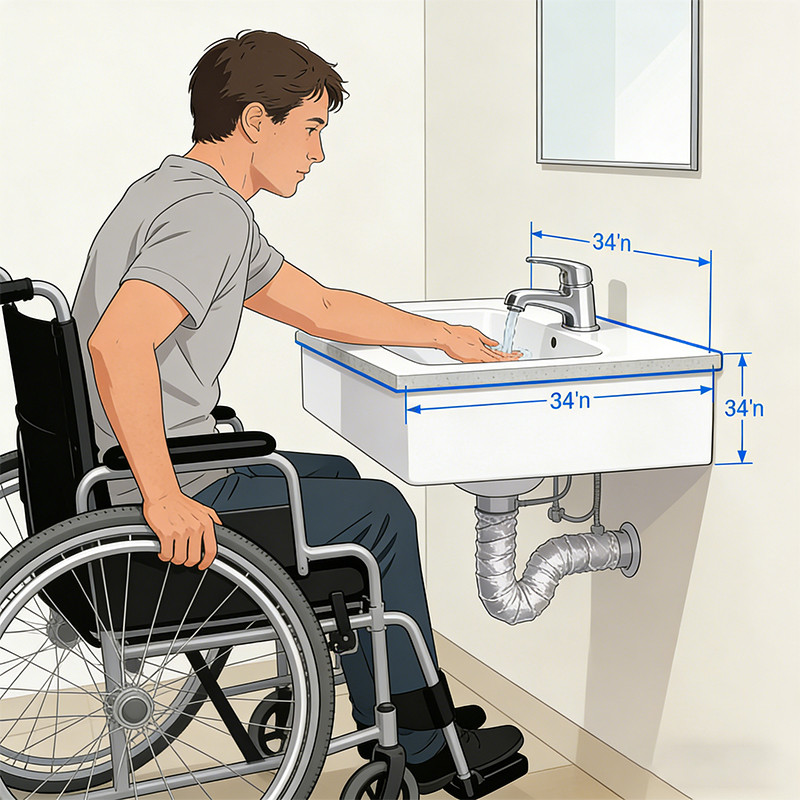
- Sink and Vanity Design is Critical for Accessibility: Sinks, including trough sinks, must have a rim height no more than 34 inches from the floor. Crucially, they require clear knee and toe space underneath to allow for a forward approach by wheelchair users. Faucet controls must be operable with one hand and minimal force.
- Trough Sinks Can Be an Excellent ADA Solution: Multi-station trough sinks can be fully ADA compliant if at least one station meets all accessibility requirements. This includes the correct height, knee clearance, and an accessible faucet. This allows for efficient, stylish, and inclusive design in high-traffic restrooms.
- Every Detail Matters: From the force required to open a door to the placement of mirrors and soap dispensers, every element of the restroom must be considered. Exposed pipes under sinks must be insulated or configured to prevent contact and injury. Proper signage is also mandated to clearly identify accessible facilities.
- Proactive Audits and Renovations are Key: Business owners should proactively assess their current facilities for non-compliance. Addressing accessibility issues, whether through minor adjustments or larger renovations, is far more cost-effective than dealing with the aftermath of a complaint or lawsuit.
Understanding ADA Compliance for Commercial Restrooms and Best Commercial Sinks for Outdoor and Wet Environments
Ensuring that commercial restrooms are fully accessible is a cornerstone of modern, responsible business practice. The Americans with Disabilities Act (ADA) provides a clear framework for this, establishing guidelines that guarantee safety and usability for people with disabilities. This is not merely a matter of following rules; it is about fostering an inclusive environment that welcomes all patrons and employees. For facilities that include outdoor or wet areas, selecting the right fixtures, such as durable, weather-resistant commercial sinks, adds another layer of consideration to ensure longevity and sustained compliance.
The Importance of ADA in Commercial Settings
The significance of ADA compliance in commercial settings extends far beyond legal obligation; it is a fundamental aspect of ethical business practice and smart customer service. According to the CDC, approximately 25% of adults in the United States live with a disability, representing a significant portion of the population that businesses should aim to serve. By implementing ADA standards, businesses actively remove barriers, ensuring that their spaces and services are open to everyone.
This commitment to inclusivity has tangible benefits. An accessible business expands its potential customer base, welcoming individuals with disabilities and their families who might otherwise be excluded. Furthermore, it creates a more inclusive workplace, enhancing the employee experience for staff members with disabilities. Embracing inclusive design often leads to a better experience for all users, not just those with disabilities, as features like wider doorways and clear navigation benefit everyone. Ultimately, prioritizing accessibility builds a positive reputation, demonstrating a company's commitment to social responsibility and community values.
Legal and Financial Implications of Non-Compliance
Ignoring ADA regulations for commercial restrooms can lead to severe legal and financial consequences. The U.S. Department of Justice (DOJ) is tasked with enforcing Title III of the ADA, which prohibits discrimination in places of public accommodation. Businesses found to be non-compliant can face substantial federal civil penalties, which can be up to $75,000 for a single, first-time violation and can increase to $150,000 for any subsequent violations.
Beyond these government-imposed fines, non-compliance opens the door to private lawsuits filed by individuals who have been denied access. These lawsuits can be incredibly costly, involving not just potential settlement amounts but also extensive legal fees for both defense and the plaintiff's attorneys, which can easily run into tens of thousands of dollars. For instance, a small business could conservatively expect a final bill of around $25,000 after a demand letter, covering legal fees and remediation costs. In addition to these direct financial burdens, there is the cost of retrofitting the facility to bring it into compliance, which is almost always more expensive than incorporating accessible design from the outset. The accumulation of these costs—fines, settlements, legal fees, and renovations—makes non-compliance a significant financial risk for any business.
Ethical Considerations and Public Perception
Beyond the legal statutes and financial risks, there is a strong ethical imperative for businesses to ensure accessibility. Providing equal access is a matter of civil rights and social responsibility. When a business designs its facilities to be inclusive, it sends a powerful message that all individuals are valued and respected. This fosters a sense of belonging and community, which is increasingly important to modern consumers. Companies that prioritize ethical practices, including accessibility, are often viewed as more trustworthy and socially conscious.
Public perception is deeply intertwined with a company's approach to accessibility. In today's socially aware marketplace, a reputation for being inaccessible or discriminatory can cause significant brand damage. Negative publicity from lawsuits or customer complaints can spread quickly, leading to a loss of customer loyalty and deterring new patrons. Studies have shown that a large majority of consumers prefer to support brands that demonstrate inclusivity. Conversely, a business known for poor accessibility may be boycotted by disabled people and their families, representing a substantial loss of revenue. Ultimately, embracing accessibility is not just the right thing to do—it's a critical component of building a positive, resilient, and respected brand.
Key ADA Requirements for Toilets and Stalls, Featuring Best Commercial Sinks for Outdoor and Wet Environments
Creating a fully compliant ADA restroom involves meticulous attention to the specifics of toilets and stalls. These elements are fundamental to ensuring that individuals with disabilities can use the facilities safely, independently, and with dignity. The regulations cover everything from the height of the toilet seat to the space required for maneuvering a wheelchair. When designing these spaces, it's also practical to consider durable fixtures like the best commercial sinks for outdoor and wet environments, which can withstand heavy use and varying conditions, ensuring the entire restroom remains functional and compliant over time.
Toilet Seat Height and Placement
The height and placement of the toilet are critical for accessibility, particularly for individuals who use wheelchairs or have mobility challenges. The 2010 ADA Standards for Accessible Design mandate a specific range for toilet seat height to facilitate easier transfers.
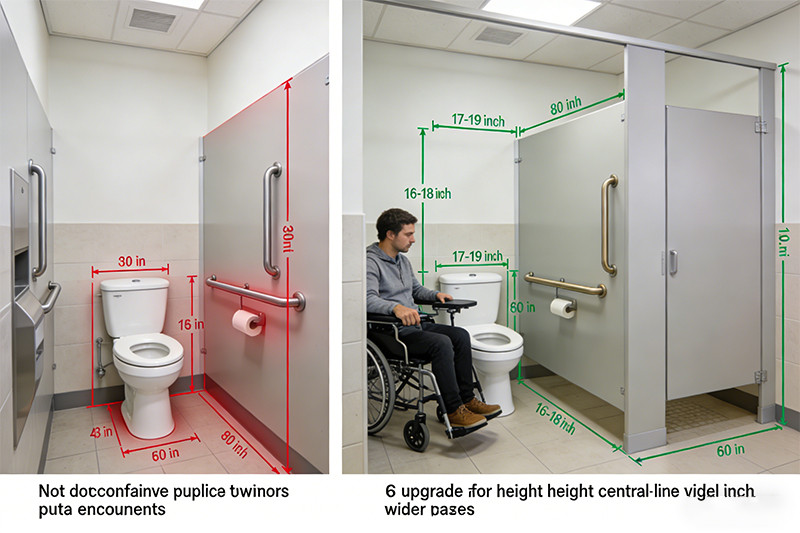
Height Requirement: The top of the toilet seat must be between 17 inches and 19 inches above the finished floor. This height range aligns with the seat height of most wheelchairs, making it less strenuous for an individual to transfer from their chair to the toilet and back. Standard, non-compliant toilets are often several inches lower, creating a significant barrier.
Placement Requirement: The centerline of the toilet must be positioned between 16 inches and 18 inches from the side wall or partition. This precise spacing ensures there is enough room for a person to position their wheelchair alongside the toilet for a side transfer, while also allowing them to comfortably reach and use the grab bar on the adjacent wall for support. Specifying 17 inches is often recommended to accommodate for minor construction variances.
In addition to these dimensional rules, the flush control must be located on the open side of the toilet (the side without a wall) to be easily reachable.
Clearance and Maneuvering Space within Stalls
Adequate clear floor space is arguably the most important element of an accessible restroom stall, as it allows individuals using mobility aids to enter, turn, and use the fixtures without obstruction. The ADA outlines specific requirements to ensure this maneuverability.
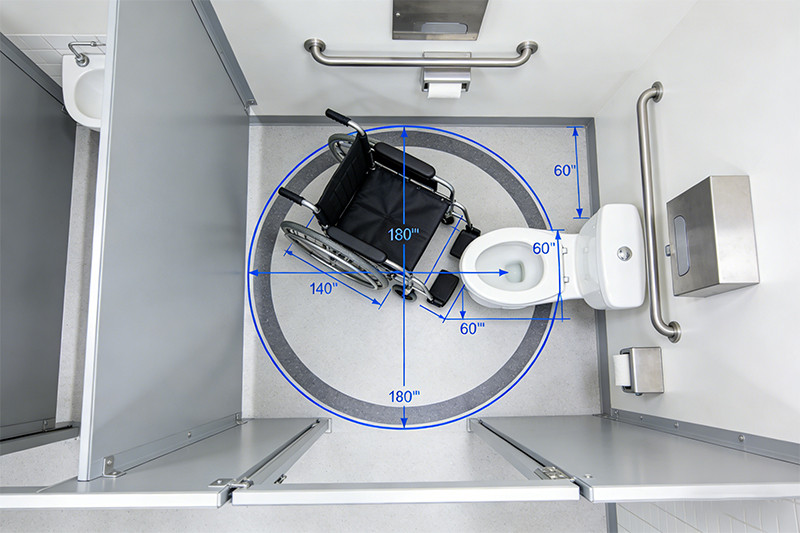
Turning Space: Public restrooms must provide a turning space that is a 60-inch diameter circle or a T-shaped space. This space is essential for a wheelchair user to make a 180-degree turn. This turning area can overlap with the clear floor space required for fixtures, but it must remain unobstructed by objects like trash cans or protruding dispensers.
Accessible Stall Dimensions: At least one toilet stall must be wheelchair accessible. These stalls must have a minimum width of 60 inches. The depth requirement varies depending on the toilet type: at least 56 inches for a wall-hung toilet and 59 inches for a floor-mounted toilet. This space ensures a person can enter the stall, close the door, and approach the toilet.
Toe Clearance: ADA standards require toe clearance of at least 9 inches high under the front partition and at least one side partition of the stall. This space allows the footrests of a wheelchair to go under the partition, providing more effective maneuvering room within the stall.
Stall doors must also comply, typically swinging outward to avoid obstructing the interior clear space and having a clear opening of at least 32 inches.
Grab Bar Specifications and Installation for Safety
Grab bars are a mandatory and crucial safety feature in any ADA-compliant restroom. They provide stability and support for individuals during transfers and repositioning. The ADA has strict rules for their size, strength, and placement to ensure they are reliable and effective.
Strength and Diameter: Grab bars must be able to withstand at least 250 pounds of force. They should have a diameter of 1.25 to 2 inches to allow for a secure grip.
Placement and Dimensions:
- Rear Wall: A horizontal grab bar at least 36 inches long must be installed on the wall behind the toilet. It should extend at least 12 inches from the toilet's centerline on one side and 24 inches on the other.
- Side Wall: A horizontal grab bar at least 42 inches long must be placed on the side wall closest to the toilet. It should be positioned no more than 12 inches from the rear wall and extend at least 54 inches from the rear wall.
- Height: All horizontal grab bars must be installed at a consistent height of 33 to 36 inches above the finished floor to the top of the gripping surface.
Clearance: There must be a gap of exactly 1.5 inches between the grab bar and the wall to ensure a user can get a firm grip without their knuckles hitting the wall.
Urinal Requirements, if Applicable
If urinals are provided in a commercial restroom, at least one must be ADA compliant to ensure it is accessible for all users.
Height and Type: The urinal must be either a stall-type or a wall-hung model with an elongated rim. The rim of the urinal must be mounted no higher than 17 inches above the finished floor.
Clear Floor Space: A clear floor space of at least 30 inches wide by 48 inches deep must be provided in front of the accessible urinal to allow for a forward approach by a person in a wheelchair. This area must remain unobstructed.
Flush Controls: The flush controls for the urinal must be accessible, meaning they can be operated with one hand without tight grasping or twisting. The control must be located no more than 44 inches above the finished floor. Automatic, sensor-based flush controls are an excellent option for meeting this requirement effortlessly.
ADA Compliant Sinks and Vanities: Beyond Just Best Commercial Sinks for Outdoor and Wet Environments
Creating a truly accessible restroom goes beyond just toilets and stalls; the sink and vanity area is equally critical. For a person in a wheelchair, something as simple as washing their hands can become impossible if the sink is too high, the faucets are hard to operate, or there are obstructions underneath. ADA guidelines for sinks and vanities are designed to ensure this essential task is barrier-free for everyone. While durability is a factor, especially when choosing the best commercial sinks for outdoor and wet environments, compliance with accessibility standards is paramount.
Height and Clearance for Wheelchair Accessibility
For a sink area to be accessible, it must accommodate a person using a wheelchair to approach it directly. This requires very specific vertical and horizontal clearances.
- Sink Height: The top edge of the sink or the counter it's set in cannot be more than 34 inches above the finished floor. This height allows a seated user to comfortably reach into the basin.
- Knee Clearance: There must be open space under the sink for a wheelchair user's knees. This space must be at least 27 inches high (from the floor to the bottom of the sink or any component underneath), 30 inches wide, and extend at least 8 inches deep from the front of the sink.
- Toe Clearance: A toe clearance of at least 9 inches in height must also be provided. This space allows the front of a wheelchair to roll further under the sink.
- Clear Floor Space: A clear floor area of at least 30 by 48 inches must be centered in front of the sink to allow for a forward approach. This space must remain unobstructed.
These dimensions are non-negotiable and are fundamental to creating a usable sink for individuals with mobility impairments.

Faucet Controls: Ease of Use and Design
The type of faucet and its operating mechanism are just as important as the sink's dimensions. Controls must be easy to use for individuals with limited hand strength or dexterity.
- Operating Force: Faucet controls must be operable with less than 5 pounds of force.
- One-Handed Operation: The mechanism must be usable with one hand and not require tight grasping, pinching, or twisting of the wrist.
- Acceptable Designs:
- Lever-operated handles are a common and compliant choice.
- Push-type mechanisms are also acceptable.
- Touchless or sensor-activated faucets are an ideal solution, as they eliminate any need for physical contact or force, making them accessible to the widest range of users.
- Metering Faucets: If a faucet is metered (meaning it shuts off automatically), it must remain on for at least 10 seconds to give the user adequate time for handwashing.
Protecting Exposed Pipes and Surfaces
A critical safety requirement for ADA-compliant sinks is the protection of exposed plumbing. Since a wheelchair user's legs will be underneath the sink, they are vulnerable to injury from hot water pipes or sharp, abrasive surfaces.
- Insulation: Hot water and drain pipes located under a sink must be insulated or otherwise configured to protect against contact.
- Protective Panels/Wraps: There are many commercially available products designed for this purpose, including padded wraps and rigid panels that enclose the plumbing. These not only prevent burns and abrasions but also provide a cleaner, more finished look.
- No Sharp Surfaces: The entire area under the sink must be free of any sharp or abrasive surfaces. This ensures that a person cannot be accidentally cut or scraped while using the sink.
Failing to protect exposed pipes is a common and dangerous violation of ADA standards.
Commercial Trough Sinks: ADA Compliance in Multi-User Environments
Trough sinks, also known as multi-station washbasins, are increasingly popular in modern commercial restrooms due to their sleek design, durability, and ability to serve multiple users at once. The good news is that trough sinks can be made fully ADA compliant.
When installing a trough sink, you don't necessarily need the entire length of the sink to meet ADA standards. The key is to ensure that at least one station is fully compliant.
- One Compliant Station: For a multi-user trough sink, at least one of the faucet areas must meet all the ADA requirements for a standard sink. This means one section must have:
- A rim height no greater than 34 inches.
- The required knee and toe clearance underneath (at least 27 inches high).
- An accessible, easy-to-operate faucet.
- Protected pipes in that section.
- Design Flexibility: This approach allows for design flexibility. The non-compliant sections of the trough sink can be installed at a standard, ergonomic height for standing users, while the designated accessible station is lowered to the 34-inch maximum height. This creates a "scalloped" or dual-level design that accommodates all users.
By ensuring at least one station is fully accessible, businesses can leverage the efficiency and aesthetic appeal of trough sinks while maintaining full ADA compliance and fostering an inclusive environment.
Overall Restroom Accessibility and Best Commercial Sinks for Outdoor and Wet Environments
A fully ADA-compliant restroom is more than the sum of its parts. While individual fixtures like toilets and sinks must meet specific criteria, the overall layout and functionality of the entire space are what truly determine its accessibility. Every detail, from the entrance door to the location of the soap dispenser, contributes to a safe and navigable environment for all users. When selecting these components, considering durable options such as the best commercial sinks for outdoor and wet environments can ensure the restroom's longevity and performance, complementing the core accessibility requirements.
Door Accessibility: Clearances, Swing, and Handle Types
The entrance to the restroom is the first point of access and must be designed to be completely barrier-free.
- Clear Width: When the door is open to 90 degrees, the clear opening must be at least 32 inches wide to accommodate wheelchairs and other mobility devices.
- Maneuvering Clearances: Adequate clear space on both sides of the door is required so a person in a wheelchair can approach, open the door, and pass through. For example, a front approach to a pull-side door requires at least 60 inches of perpendicular clearance and 18 inches of clearance on the latch side.
- Door Swing: Restroom doors should not swing into the clear floor space required for any fixture. In single-user restrooms, a door can swing in only if there is sufficient clear space beyond the door's arc. For accessible toilet stalls, doors must always swing outward.
- Handle Hardware: Door handles must be operable with one hand and not require tight grasping, pinching, or twisting of the wrist. Lever handles, push-type mechanisms, and U-shaped pulls are compliant. Standard round doorknobs are not. The hardware must be installed between 34 and 48 inches above the floor.
- Opening Force: The force required to open an interior hinged door must not exceed 5 pounds.
Placement of In-Wall Fixtures and Mirrors
The placement of all fixtures and accessories is governed by ADA standards to ensure they are within reach and usable by a person in a seated position.
- Accessory Height: The operable parts of accessories like soap dispensers, paper towel dispensers, and hand dryers must be located no more than 48 inches above the finished floor. Recessed accessories are ideal because they do not protrude into the circulation path.
- Mirror Mounting Height: If a mirror is installed above a lavatory or counter, the bottom edge of its reflective surface must be no higher than 40 inches from the floor. For mirrors not located over a counter, the bottom edge must be no higher than 35 inches from the floor. A single, full-length mirror can often meet the needs of a wider range of users, including children and seated individuals.
Addressing Projections from Walls for Clear Pathways
To ensure safe navigation, especially for individuals with vision impairments, the ADA limits how far objects can protrude into a circulation path.
- The 4-Inch Rule: Objects mounted on the wall with their leading edge between 27 inches and 80 inches from the floor cannot project more than 4 inches into the path. This applies to items like towel dispensers, hand dryers, andshelving.
- Cane Detection: Objects with a leading edge at or below 27 inches from the floor can protrude any amount, as they can be detected by a person using a cane. If a protruding object is mounted higher than 27 inches, a detectable barrier or element must be placed below it.
- Headroom Clearance: Circulation paths must have a minimum headroom clearance of 80 inches. Any overhead object that hangs below this height, such as a sign or a low-hanging pipe over a walkway, must have a guardrail or other barrier to warn individuals with vision impairments.
Proper Signage and Alternative Accessible Restrooms
Clear and compliant signage is essential for identifying accessible restrooms and guiding individuals to them.
- Sign Requirements: Signs identifying permanent rooms like restrooms must have both tactile (raised) text and Grade 2 Braille. They must also feature a non-glare finish and high contrast between the characters and the background.
- Placement: The sign should be mounted on the wall adjacent to the latch side of the restroom door. The baseline of the tactile text should be between 48 and 60 inches from the floor. An 18 by 18-inch clear floor space must be centered on the sign, outside of the door's swing arc.
- Pictograms: Signs should use the International Symbol of Accessibility where applicable.
- Alternative Restrooms: If altering existing men's and women's restrooms to be fully compliant is not feasible, a business may be permitted to provide a single-user, unisex accessible restroom as an alternative. This alternative restroom must be located in the same area and on the same floor as the non-compliant restrooms.
Ensuring Accessibility for All with Baby Changing Stations and Showers
For facilities that offer additional amenities like baby changing stations or showers, these must also comply with ADA standards to be accessible.
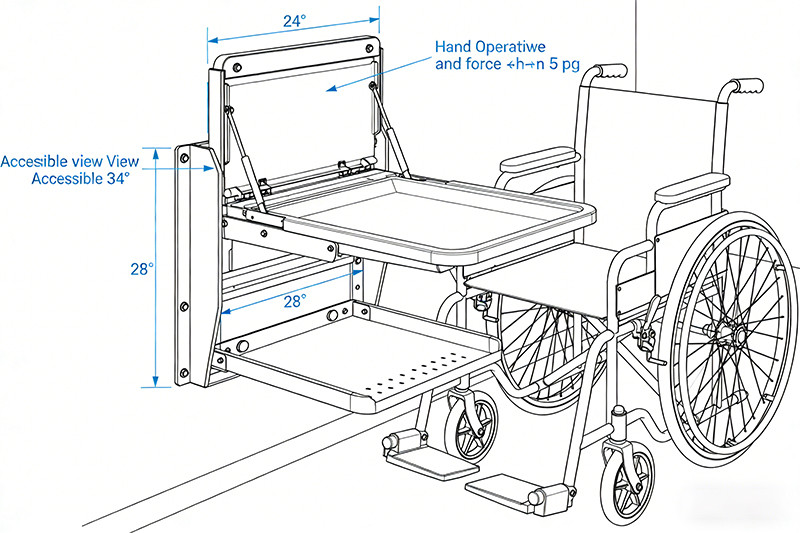
- Baby Changing Stations: These are considered work surfaces under the ADA. When open, the changing surface must be between 28 and 34 inches high. There must be clear knee and toe space underneath, and the station must be operable with one hand, requiring less than 5 pounds of force. The station, whether open or closed, cannot obstruct the accessible route.
- Showers: There are two main types of ADA-compliant showers:
- Transfer Showers: These must have inside dimensions of exactly 36 by 36 inches and include a seat, allowing a user to transfer from a wheelchair.
- Roll-In Showers: These are larger, with minimum inside dimensions of 30 by 60 inches, and have a very low or no threshold, allowing a user to roll their wheelchair directly into the shower.
- Both types require grab bars, accessible controls that are easy to operate, and a handheld shower spray unit with a hose at least 59 inches long.
Making Your Existing Commercial Restroom ADA Compliant: Practical Steps and Best Commercial Sinks for Outdoor and Wet Environments
Bringing an existing commercial restroom into compliance with the Americans with Disabilities Act (ADA) can seem like a daunting task, but it is a crucial investment in inclusivity, legal protection, and brand reputation. The process involves a thorough assessment of your current facilities, followed by strategic renovations. Whether the changes are minor adjustments or a complete overhaul, using durable and appropriate materials, like the best commercial sinks for outdoor and wet environments, can ensure your upgrades are both compliant and long-lasting.
Assessing Your Current Facility for Non-Compliance
The first step in any renovation project is a thorough assessment of your existing restroom. This audit should be methodical and detail-oriented, comparing every aspect of your facility against the 2010 ADA Standards for Accessible Design.
A comprehensive checklist should be used to evaluate key areas:
- Path of Travel: Is the route to the restroom clear of obstructions? Are the doorways at least 32 inches wide?
- Signage: Is there a compliant sign with tactile text and Braille on the latch side of the door?
- Stall Dimensions: Does the accessible stall meet the width and depth requirements (at least 60 inches wide)? Is there a 60-inch turning radius?
- Toilet: Is the toilet seat height between 17 and 19 inches? Is it correctly positioned from the side wall?
- Grab Bars: Are the grab bars installed at the correct height (33-36 inches), length, and location on the rear and side walls?
- Sink and Vanity: Is the sink rim no higher than 34 inches? Is there proper knee and toe clearance underneath? Are the pipes protected?
- Faucets and Dispensers: Are all controls and dispensers operable with one hand and within the proper reach range (no higher than 48 inches)?
It is highly recommended to hire a Certified Access Specialist (CASp) or a contractor experienced in ADA regulations to conduct this assessment. They can identify subtle yet critical non-compliance issues that might otherwise be missed.
Strategies for Renovating Toilets, Sinks, and Showers
Once you have identified the areas of non-compliance, you can develop a renovation strategy.
Toilets: If a toilet is too low, it can often be replaced with a taller, "comfort height" model that sits at the required 17-19 inch height. Relocating a toilet to meet the 16-18 inch centerline requirement is a more involved plumbing job but is essential for compliance. This may also require reconfiguring partitions to achieve the necessary 60-inch stall width.
Sinks: To make a sink accessible, you may need to remount it at a maximum height of 34 inches. If the sink is in a cabinet, the cabinet will likely need to be removed to provide the necessary knee clearance. Wall-mounted sinks are an excellent choice for new installations or renovations. Remember to install pipe wrap or insulation on all exposed plumbing underneath.
Showers: Creating an accessible shower often involves significant changes. Converting a traditional bathtub or high-curb shower into a curbless, roll-in model is a common strategy. This requires proper waterproofing and sloping of the floor to ensure drainage. The renovation must also include installing a seat (for transfer showers), multiple grab bars, and a handheld showerhead.
Cost-Effective ADA Renovation Solutions
While some renovations are inherently costly, there are several ways to manage expenses and achieve compliance without a complete overhaul.
- Prioritize a Phased Approach: Address the most critical barriers first. Simple fixes like changing door hardware, repositioning dispensers, and installing grab bars are relatively inexpensive but have a major impact on accessibility.
- Lever-Style Handles: Replacing round doorknobs and twist-style faucet handles with compliant lever-style hardware is a low-cost, high-impact upgrade.
- Offset Hinges: If a doorway is slightly too narrow, installing offset hinges can add an extra 1-2 inches of clear width, which may be enough to achieve compliance without reframing the door.
- Portable Shower Seats: In some cases, a sturdy, portable shower seat can be a budget-friendly alternative to a built-in one, though built-in is preferred for stability.
- Tax Incentives: Small businesses may be eligible for federal tax credits and deductions to help offset the cost of ADA renovations. The Disabled Access Credit (IRS Form 8826) can provide significant financial relief.
Long-Term Benefits of ADA Compliance
Investing in an ADA-compliant restroom is not just an expense; it is a strategic decision with significant long-term benefits that contribute positively to a business's success and reputation.
- Expanded Customer Base: A fully accessible facility welcomes a larger segment of the population. This includes not only the millions of Americans with disabilities but also their families, friends, and caregivers who will choose to patronize establishments that are inclusive.
- Enhanced Brand Reputation: In a socially conscious market, businesses that prioritize accessibility are viewed as ethical and responsible. This builds goodwill and fosters strong customer loyalty, which is more powerful than paid advertising.
- Reduced Legal Risk: The most immediate benefit is the avoidance of costly lawsuits and federal fines. Proactive compliance is a form of legal insurance that protects a business from potentially devastating financial and reputational damage.
- Improved Employee Morale and Productivity: An inclusive workplace can attract a wider pool of talent and boost morale and productivity among all employees. When people feel valued and their environment is accommodating, it fosters a more positive and efficient workplace.
- Future-Proofing Your Business: As the population ages, the number of individuals with mobility challenges will increase. Investing in accessibility now ensures your business will remain welcoming and relevant for years to come, solidifying its position in the community.
Ultimately, ADA compliance is a smart business move that pays dividends in customer loyalty, brand strength, and long-term financial stability.
Frequently Asked Questions (FAQ)
1. What is the main purpose of ADA compliance for commercial restrooms? The primary purpose of the Americans with Disabilities Act (ADA) in the context of commercial restrooms is to prohibit discrimination on the basis of disability by ensuring equal access to public facilities. It mandates specific design standards so that individuals with disabilities, including those who use wheelchairs or have mobility, sensory, or dexterity impairments, can use the restroom safely, independently, and with dignity.
2. What are the most common ADA violations found in older commercial restrooms? Common violations often include incorrect toilet height (too low), insufficient clear floor space for maneuvering a wheelchair, missing or improperly installed grab bars, sinks mounted too high without knee clearance, non-compliant faucet and door handles (e.g., round knobs), and inaccessible pathways or doorways. Another frequent issue is having exposed hot water and drain pipes under sinks, which poses a burn risk.
3. Do all sinks in a multi-user restroom need to be ADA compliant? No, not all sinks must be compliant. In a restroom with multiple sinks, such as a long trough sink or a bank of individual vanities, only one sink station is required to be fully ADA compliant. This station must meet all the criteria, including the 34-inch maximum height, knee and toe clearance, and accessible faucet controls. The other sinks can be at a standard height for standing users.
4. Can I use a round doorknob on an ADA-compliant restroom door? No, round doorknobs are not ADA compliant because they require tight grasping and twisting of the wrist to operate. ADA standards mandate that door hardware must be operable with one hand and without these motions. Acceptable alternatives include lever-operated handles, push-type mechanisms, and U-shaped pulls.
5. Are automatic, sensor-operated faucets and soap dispensers required for ADA compliance? While not explicitly required, sensor-operated (touchless) fixtures are an excellent way to meet ADA standards. The requirement is that faucets and dispensers must be operable with one hand, with minimal force (less than 5 lbs), and without tight grasping or pinching. Since sensor-activated fixtures require no physical contact, they inherently fulfill these operational requirements and provide the highest level of accessibility.
6. How do I protect the pipes under an ADA-compliant sink? Exposed hot water and drain pipes under an accessible sink must be insulated or otherwise covered to protect against contact, which could cause burns or abrasions. There are many commercial products available, such as pre-formed foam insulation wraps or rigid plastic covers (often called P-trap covers), that are specifically designed to fit over the pipes and supply lines. This is a critical and non-negotiable safety feature.
7. My restroom door is a little too narrow. Do I have to replace the entire frame? Not necessarily. If the door's clear width is only slightly less than the required 32 inches, you might be able to use "offset hinges" or "swing-clear hinges." These special hinges pivot in a way that allows the door to swing completely clear of the opening, which can add up to 2 inches of usable clear space. This can be a very cost-effective solution compared to widening the entire doorway.
8. What are the "long-term benefits" of making my restroom ADA compliant? Beyond avoiding lawsuits and fines, the long-term benefits are substantial. You expand your potential customer base to include people with disabilities and their families, leading to increased revenue. It significantly improves your brand's public image, portraying your business as socially responsible and inclusive, which builds customer loyalty. It also creates a more welcoming environment for employees with disabilities and future-proofs your facility for an aging population.
Conclusion
Adhering to ADA guidelines in commercial restrooms, including the careful selection and installation of features like ADA compliant trough sinks, is not merely a legal obligation; it's a testament to a business's commitment to inclusivity and respect for all individuals. The detailed requirements for everything from stall dimensions and grab bar placement to sink heights and faucet controls are all designed with a singular goal: to remove barriers and ensure equal access.
By prioritizing accessibility, we create environments that are welcoming, safe, and functional for everyone, thereby enhancing our brand image, avoiding legal issues, and fostering a more equitable society. Taking the steps to assess, renovate, and maintain a compliant restroom is an investment that pays dividends in customer loyalty, community reputation, and the fundamental satisfaction of doing the right thing. We encourage all business owners and facility managers to embrace these standards not as a burden, but as an opportunity to build a better, more inclusive world. Please share this guide to help others create accessible spaces for all.