Handcrafted vs. Mass-Produced: The Technology of Stainless Steel Sinks
- Share
- Issue Time
- Dec 17,2025
Summary
Choosing a kitchen sink often involves deciding between handcrafted and mass-produced stainless steel options, both offering durability, aesthetic appeal, and ease of cleaning, yet differing significantly in manufacturing, performance, and cost. Mass-produced sinks are made by stamping a single steel sheet, leading to potential thinning at corners and limiting design to rounded shapes. They are generally more affordable, utilizing efficient automated processes which make them widely available.
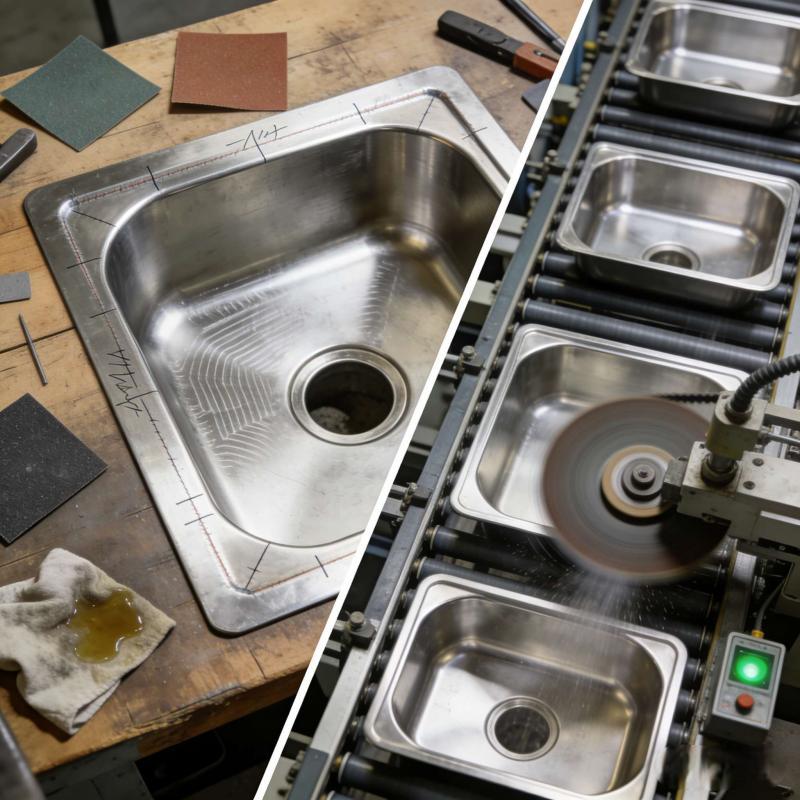
When it comes to choosing a new kitchen sink, the decision often boils down to two main types: handcrafted and mass-produced stainless steel sinks. Both options offer the inherent benefits of stainless steel, such as durability, aesthetic appeal, and ease of cleaning, but their manufacturing processes lead to significant differences in performance, design, and cost.
I'm here to guide you through the intricate world of stainless steel sink manufacturing, exploring the technology behind both handcrafted and mass-produced options. We'll uncover what sets them apart, helping you make an informed choice that perfectly suits your kitchen's needs and your personal preferences.
Understanding the technology and craftsmanship involved in creating these essential kitchen fixtures is key to appreciating their value and longevity.
Key Takeaways
Choosing between a handcrafted and a mass-produced stainless steel sink depends heavily on your priorities regarding budget, aesthetics, and long-term durability. Here are the essential points to consider before making a decision:
- Manufacturing Process Defines the Sink: The core difference lies in how they are made. Mass-produced sinks are created by stamping a single sheet of steel, which can cause thinning at the corners. Handcrafted sinks are fabricated by cutting, folding, and welding thicker, uniform sheets of steel, resulting in superior structural integrity.
- Material and Gauge Matter: Stainless steel's quality is determined by its composition, primarily its chromium and nickel content (like in 304-grade steel), which provides rust resistance. The gauge, or thickness, of the steel is a critical factor for durability. Handcrafted sinks typically use thicker 16-gauge or even 14-gauge steel, offering better resistance to dents and noise. Mass-produced sinks often use thinner 18-gauge or 22-gauge steel.
- Design and Aesthetics are Distinct: The stamping process limits mass-produced sinks to softer, rounded corners. While easy to clean, this restricts design possibilities. Handcrafted sinks offer immense design freedom, including modern zero-radius corners, integrated ledges for accessories, custom drain placements, and a variety of sophisticated finishes like PVD coatings.
- Durability and Longevity: The uniform thickness and robust TIG welds of a handcrafted sink make it significantly more durable and less prone to denting and warping over time. While a mass-produced sink is perfectly functional, its stretched corners can be a weak point.
- Noise and Maintenance: Thicker steel naturally dampens noise from water and dishes more effectively. Both types use sound-dampening pads, but they are often more substantial on premium handcrafted models. While the rounded corners of mass-produced sinks are simple to wipe down, the advanced finishes on many handcrafted sinks can also repel water and grime, simplifying maintenance.
- Cost vs. Long-Term Value: Mass-produced sinks are the clear winner in terms of upfront affordability. They offer reliable performance for a modest price. Handcrafted sinks represent a significant investment but pay off in long-term value through superior durability, timeless design, and enhanced functionality, often becoming a centrepiece of the kitchen.
- Making the Right Choice for You: If your priority is a budget-friendly, functional sink for a standard kitchen, a mass-produced model is an excellent choice. If you are designing a high-end kitchen, desire custom features, and view the sink as a long-term investment in quality and style, a handcrafted sink is the superior option.
Ultimately, understanding the technology behind each sink type empowers you to look beyond the price tag and choose a fixture that truly aligns with your kitchen's needs and your personal vision for the space.
The Core of Stainless Steel Sinks: Material and What Makes it 'Stainless'
Before diving into the manufacturing differences, it's crucial to understand the material itself. Stainless steel is the undisputed champion for kitchen sinks, prized for its longevity, hygienic properties, and timeless look. But what exactly gives it these qualities?
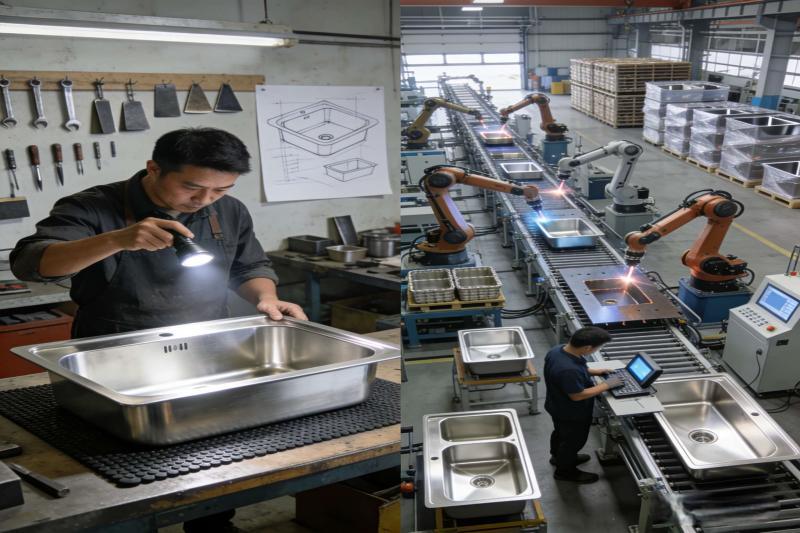
What Defines Stainless Steel?
Stainless steel is not a single metal but an iron-based alloy. Its defining characteristic is its resistance to corrosion and rust, a quality it owes primarily to the presence of chromium. To be classified as "stainless," the steel alloy must contain a minimum of 10.5% chromium by mass.
When exposed to oxygen, the chromium in the alloy forms a thin, invisible, and durable passive layer of chromium oxide on the surface. This layer is "passive" because it prevents further oxidation (rusting) and self-repairs almost instantly if scratched or damaged.
The most common and reputable type of stainless steel used for kitchen sinks is Type 304, often referred to by its chromium and nickel content, 18/8 stainless steel. This means it is composed of approximately 18% chromium and 8% nickel. The nickel enhances the steel's formability, corrosion resistance, and luster, making it an ideal material for the demanding kitchen environment.
Magnetic Properties of Stainless Steel in Sinks
A common misconception is that if a magnet sticks to your stainless steel sink, it must be of low quality. This is not necessarily true. The magnetic properties of stainless steel are determined by its microscopic crystalline structure.
- Austenitic Stainless Steel (e.g., Type 304): In its pure, annealed state, Type 304 stainless steel has an austenitic structure, which is non-magnetic. This is the state of the raw steel sheet before it is manufactured into a sink.
- Work Hardening and Magnetism: The manufacturing process, especially the stamping and bending involved in making both mass-produced and handcrafted sinks, alters this structure. This process, known as "cold working" or "work hardening," can cause some of the austenitic crystals to transform into a magnetic martensitic structure.
Therefore, it is perfectly normal for a high-quality 304 stainless steel sink to exhibit some magnetism, particularly in the corners and on the edges where the metal has been bent and stressed the most. Magnetism is not a reliable indicator of quality or rust resistance; the chromium and nickel content are far more important factors.
Mass-Produced Sinks: The Traditional Approach with Automated Technology
Mass-produced stainless steel sinks are the most common type found in homes today. Their popularity stems from their affordability and consistent availability, a direct result of a highly efficient and automated manufacturing process centered around a technique called deep drawing or stamping.
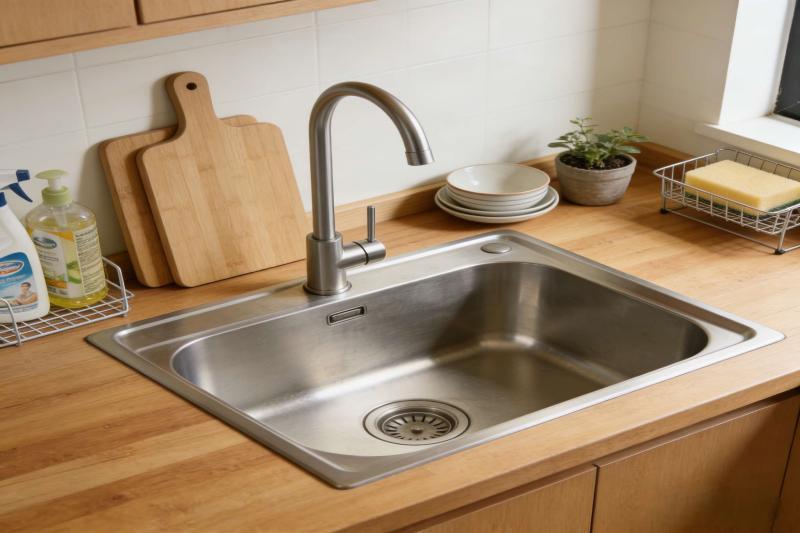
Manufacturing Process: Stamping and Shaping
The creation of a mass-produced sink begins with a single, flat sheet of stainless steel. This sheet is placed into a massive hydraulic press, which uses a die in the shape of the sink to press and stretch the steel into the desired form. This entire process is known as "deep drawing."
- Stamping (Drawing): A powerful punch forces the steel sheet into the die cavity, transforming the flat metal into a three-dimensional sink bowl. This single-step process is incredibly fast and efficient, allowing for the production of thousands of identical sinks per day.
- Annealing: The drawing process creates immense stress in the steel. To relieve this stress and prevent cracking, the formed sink may be heated in a process called annealing, which softens the metal before it is trimmed and finished.
- Finishing: The sink's drain hole is punched out, the edges are trimmed, and the surface is polished to create the final look.
This automated approach minimizes manual labor and maximizes output, which is the primary reason for the accessible price point of mass-produced sinks.
Material Thickness and Durability Concerns
A significant drawback of the stamping process is its effect on the material's thickness. As the flat sheet of steel is stretched to form the sink bowl, the material becomes thinner. This thinning is most pronounced at the corners and the bottom of the sink, the areas that were stretched the most.
This means that while the manufacturer might start with a sheet of 18-gauge steel, the finished sink's corners could be as thin as 22-gauge or even less. These thinner sections are inherently weaker and more susceptible to:
- Denting: A dropped pot or heavy pan is more likely to leave a permanent dent in the stretched corners of a stamped sink.
- Vibration and Noise: Thinner steel vibrates more easily, leading to more noise from running water and dishes clattering in the basin.
- Flexing: The sink deck, especially on top-mount models, can feel flimsy and may flex under the weight of a heavy faucet.
Design Limitations and Aesthetic Considerations
The physics of deep drawing imposes strict limitations on sink design. To prevent the steel from tearing during the stamping process, the sink must have large, rounded corners. Attempting to create sharp, angular corners with this method would cause the metal to rip apart under the strain.
As a result, mass-produced sinks are almost exclusively characterized by:
- Generous Corner Radii: The inside corners of the bowl are noticeably curved.
- Simple, organic shapes: The designs are typically basic, lacking the complex architectural lines or integrated features found in handcrafted models.
- Uniformity: Since all sinks come from the same die, there is little to no room for customization in size or features.
While these rounded corners are often praised for being easy to wipe clean, they define a softer, more traditional aesthetic that may not align with modern kitchen design trends that favor crisp, clean lines.
Handcrafted Sinks: Precision Craftsmanship and Advanced Technology
Handcrafted sinks, often referred to as fabricated sinks, represent a fusion of skilled artisanship and advanced manufacturing technology. Unlike their mass-produced counterparts, these sinks are not stamped from a single sheet. Instead, they are constructed from individual panels of a high-quality, thicker stainless steel, resulting in superior durability and design flexibility.
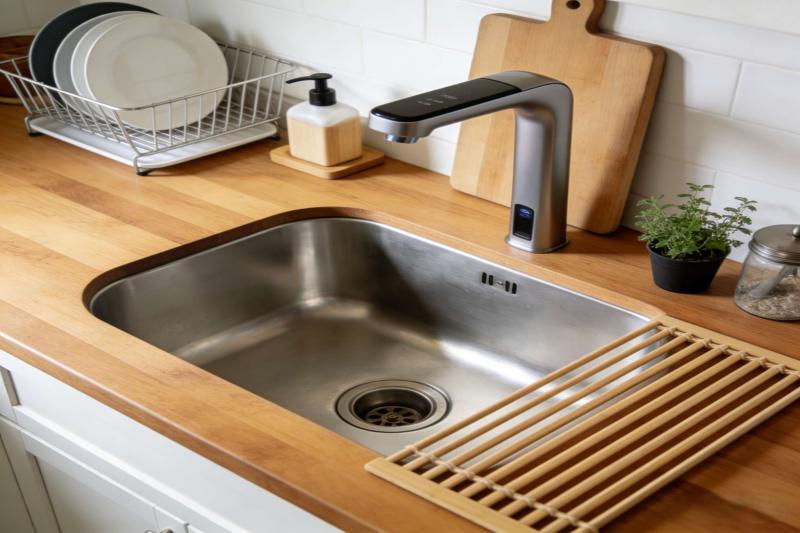
The Art of Fabrication: Laser Cutting and TIG Welding
The fabrication of a handcrafted sink is a deliberate, multi-step process that prioritizes precision over speed.
- Laser Cutting: The process begins with a sheet of heavy-gauge stainless steel. Instead of being stamped, individual panels for the sink's base and walls are cut with extreme precision using high-powered lasers. This technology allows for flawless, clean cuts and the creation of intricate shapes and features that are impossible with stamping.
- Bending and Forming: The flat panels are then carefully bent and folded using a machine called a press brake to form the walls of the sink. Because the steel is folded rather than stretched, it maintains its original, uniform thickness throughout the entire structure.
- TIG Welding: The seams where the panels meet are fused together by a skilled artisan using TIG (Tungsten Inert Gas) welding. This highly precise welding method produces a strong, clean, and seamless join that is often stronger than the original metal itself. The welds are then meticulously ground and polished by hand until they are completely invisible, creating a flawless, monolithic appearance.
Enhanced Durability through Thicker Gauge Steel
One of the most significant advantages of a handcrafted sink is the ability to use thicker steel. Since the metal is not stretched, manufacturers can use robust 16-gauge or even commercial-grade 14-gauge stainless steel.
Gauge refers to the thickness of the steel; a lower number indicates a thicker sheet. The difference is substantial:
- 16-gauge steel is about 1.59mm thick.
- 18-gauge steel (common in higher-end stamped sinks) is about 1.27mm thick.
- 22-gauge steel (found in budget stamped sinks) is only about 0.79mm thick.
This uniform, thicker construction gives handcrafted sinks exceptional resistance to denting, bowing, and vibration, ensuring they can withstand heavy daily use for decades.
| Gauge Number | Thickness (Inches) | Thickness (mm) | Common Use Case | Durability |
|---|---|---|---|---|
| 14-Gauge | 0.0781" | 1.98 | Premium Handcrafted, Commercial | Exceptional |
| 16-Gauge | 0.0625" | 1.59 | High-End Handcrafted Sinks | Excellent |
| 18-Gauge | 0.0500" | 1.27 | Mid-to-High-End Stamped Sinks | Good |
| 20-Gauge | 0.0375" | 0.95 | Budget Stamped Sinks | Fair |
| 22-Gauge | 0.0313" | 0.79 | Economy Stamped Sinks | Poor |
Design Flexibility: From Sharp Corners to Integrated Features
The fabrication process liberates sink design from the constraints of stamping. This allows for a vast array of aesthetic and functional possibilities that define high-end kitchens:
- Zero-Radius and Tight-Radius Corners: Handcrafted sinks are famous for their sharp, zero-radius or slightly curved tight-radius corners (e.g., R10 or R15). This creates a crisp, architectural look that is highly sought after in modern and minimalist design.
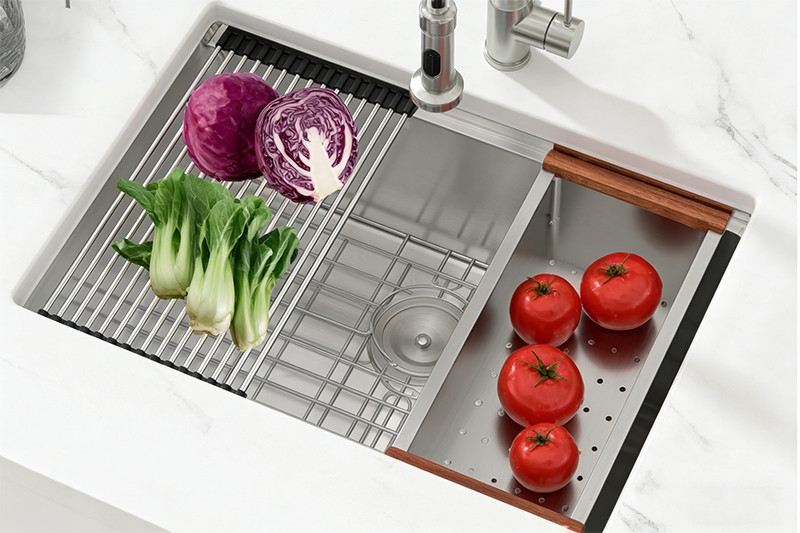
- Integrated Ledges and Accessories: Many handcrafted sinks feature a built-in ledge system. This allows workstation accessories like cutting boards, colanders, and drying racks to slide across the top of the sink, creating a versatile and efficient food prep area.
- Customization: Because they are not made from a mold, handcrafted sinks can be customized in terms of dimensions, bowl configuration, and drain placement to perfectly suit a user's specific workflow and kitchen layout.
Embracing Emerging Technologies
The world of handcrafted sinks is also at the forefront of adopting new finishing technologies that enhance both aesthetics and performance.
- PVD (Physical Vapor Deposition) Finishes: This advanced process deposits a thin layer of ceramic-based material onto the stainless steel in a vacuum chamber. PVD creates stunning and highly durable finishes in colors like gold, gunmetal, copper, and matte black. This finish is significantly more resistant to scratches and wear than simple paint or plating.
- Nano Coatings: Some premium handcrafted sinks are treated with a hydrophobic and oleophobic nano-coating. This invisible layer helps repel water and oil, preventing water spots and grime from sticking to the surface and making the sink remarkably easy to clean.
Performance and Value: A Head-to-Head Comparison
When choosing a sink, understanding the technical differences is only half the battle. The real decision comes down to how these differences translate into real-world performance, longevity, and overall value. Let's compare handcrafted and mass-produced sinks side-by-side on the factors that matter most in a busy kitchen.
Longevity and Real-World Durability
This is where the uniform thickness of handcrafted sinks provides a clear advantage.
- Handcrafted Sinks: Constructed from heavy 16-gauge or 14-gauge steel, these sinks are built like tanks. Their robust, uniformly thick walls and base are highly resistant to denting from dropped pots and pans. The high-quality TIG welds create seams that are exceptionally strong, ensuring the sink's structural integrity for a lifetime.
- Mass-Produced Sinks: The stretched, thinner corners of a stamped sink are its Achilles' heel. These areas are significantly more prone to denting, which can be difficult or impossible to repair. While a good quality 18-gauge stamped sink will serve well for years, it simply does not have the same inherent resistance to impact and wear as its handcrafted counterpart.
Winner: Handcrafted Sinks
Maintenance and Cleanliness
The debate over cleaning is more nuanced and often comes down to personal preference and sink features.
- Mass-Produced Sinks: Their large, rounded corners are universally acknowledged as being very easy to wipe clean. There are no tight angles where food particles or grime can get trapped, making daily maintenance simple.
- Handcrafted Sinks: A common concern is that zero-radius corners are difficult to clean. While they do require more intentional cleaning with a brush or cloth compared to just wiping, it is a manageable task. Furthermore, many modern handcrafted sinks feature slightly eased tight-radius corners (R10) that offer a good compromise. Crucially, the advanced nano-coatings available on some premium handcrafted models can make them even easier to clean than a standard stamped sink by preventing residue from sticking in the first place.
Winner: Tie (depends on corner radius and available coatings)
Noise Reduction and Acoustic Qualities
The sound of water splashing or dishes being washed can be a significant source of noise in an open-concept living space.
- Handcrafted Sinks: The greater mass and rigidity of thick 16-gauge steel naturally dampen vibrations, resulting in a much quieter sink. These models are almost always equipped with large, thick sound-absorbing pads covering most of the sink's exterior, along with a layer of spray-on undercoating to further deaden sound and prevent condensation.
- Mass-Produced Sinks: Thinner steel vibrates more readily, acting like a drum. While most manufacturers apply sound-dampening pads and undercoating, these are often smaller, thinner, and less effective than those found on premium handcrafted models, especially on budget-friendly sinks.
Winner: Handcrafted Sinks
Pricing and Long-Term Investment
Cost is often the most decisive factor for many buyers.
- Mass-Produced Sinks: With a highly efficient, automated manufacturing process, these sinks offer an unbeatable price point. They provide excellent functionality for a relatively small investment, making them an ideal choice for budget renovations, rental properties, or homeowners who prioritize cost above all else.
- Handcrafted Sinks: The use of more material (thicker steel), advanced technology (lasers, TIG welding), and skilled manual labor makes handcrafted sinks significantly more expensive upfront. However, this cost should be viewed as a long-term investment. You are paying for superior durability that will likely outlast the kitchen itself, timeless design that won't look dated, and enhanced functionality that can improve your daily workflow.
Winner: Mass-Produced Sinks (for upfront cost) / Handcrafted Sinks (for long-term value)
| Feature | Handcrafted Sink | Mass-Produced Sink |
|---|---|---|
| Manufacturing | Fabricated (Cut, Fold, Weld) | Stamped (Deep Drawn) |
| Steel Gauge | Thicker (14 or 16-gauge) | Thinner (18, 20, or 22-gauge) |
| Durability | Excellent, dent-resistant | Good, but corners are prone to dents |
| Corners | Zero-radius or tight-radius | Large, rounded radius |
| Design | Highly flexible, modern, customizable | Limited, traditional, uniform |
| Noise Level | Very quiet due to thick steel | Can be noisy, depends on dampening |
| Cost | Higher upfront investment | Very affordable |
| Long-Term Value | High, seen as a permanent fixture | Good, functional value for the price |
Why Your Choice Matters: Aligning with Your Kitchen's Needs
The decision between a handcrafted and a mass-produced sink isn't just about technology; it's about making a choice that reflects your lifestyle, design vision, and financial plan. Both sink types serve the same basic function, but they cater to very different priorities.
Prioritizing Functionality and Aesthetic
Your kitchen is a reflection of your personal style. The sink, as one of the most-used fixtures, plays a major role in defining the room's overall aesthetic and workflow.
- For the Design-Forward Homeowner: If you envision a sleek, contemporary, or minimalist kitchen, a handcrafted sink is almost a necessity. Its crisp zero-radius corners, architectural presence, and potential for custom features like integrated workstations and unique PVD finishes allow it to act as a functional centerpiece. You are prioritizing an aesthetic where clean lines and sophisticated details matter.
- For the Practical Traditionalist: If your style leans more traditional or you simply want a reliable sink that blends seamlessly into the background, a mass-produced model is a perfect fit. Its soft, rounded corners create a less assertive look, and its simple design is timeless in its own way. Here, the priority is straightforward function over high-concept design.
Considering Budget and Overall Value
Your budget is a primary driver in any renovation project. The key is to distinguish between upfront cost and long-term value.
- Investing for the Long Haul: A handcrafted sink is a classic "buy it for life" purchase. The higher initial cost is justified by its incredible durability and timeless appeal. For a "forever home" or a high-end kitchen remodel where quality and longevity are paramount, the long-term value of a handcrafted sink is undeniable.
- Smart and Sensible Spending: A mass-produced sink delivers exceptional value for its price. It provides a durable, reliable, and attractive basin for a fraction of the cost of a handcrafted model. This makes it the intelligent choice for homeowners on a tight budget, those renovating a second home or rental property, or anyone who would rather allocate more of their budget to other kitchen features like countertops or appliances.
Sustainability and Environmental Impact
For the eco-conscious consumer, sustainability is another important consideration.
Stainless steel, in general, is a highly sustainable material. It is exceptionally durable, and most stainless steel products, including sinks, contain a high percentage of recycled material—often 60% or more. Furthermore, stainless steel is 100% recyclable at the end of its long life.
When comparing the two types, the argument can be made from two angles:
- The Durability Argument: A handcrafted sink's immense durability means it may never need to be replaced, reducing the consumption of resources and energy associated with manufacturing and shipping a new product.
- The Manufacturing Process: Both processes are energy-intensive. Stamped sink production is highly efficient but relies on large-scale industrial machinery. Handcrafted production involves multiple steps, including energy-intensive laser cutting and welding.
Ultimately, choosing any high-quality stainless steel sink is a responsible environmental choice due to the material's longevity and recyclability. The most sustainable choice is the one that best suits your needs and will remain in your kitchen for the longest possible time, minimizing the need for replacement.
Frequently Asked Questions (FAQ)
1. Is a 16-gauge sink really that much better than an 18-gauge sink?
Yes, the difference is significant. Because the gauge scale is logarithmic, the jump from 18-gauge (1.27mm) to 16-gauge (1.59mm) represents a 25% increase in thickness. This added material makes a 16-gauge sink noticeably more resistant to dents, quieter during use, and feel more solid and premium. While a quality 18-gauge stamped sink is good, a 16-gauge handcrafted sink is in a different league of durability.
2. Will a handcrafted sink with zero-radius corners be hard to clean?
It requires a different cleaning technique but isn't necessarily "hard." You can't just wipe the corners clean; you need to use a sponge, cloth, or brush to get directly into the 90-degree angle. However, many users find this quick and easy to incorporate into their routine. For those concerned, tight-radius (R10 or R15) corners offer a modern look while being slightly easier to wipe down. Additionally, sinks with nano-coatings can make cleaning even easier by preventing grime buildup.
3. Why is my non-magnetic 304 stainless steel sink slightly magnetic in the corners?
This is completely normal and not a sign of poor quality. Type 304 stainless steel is non-magnetic in its raw state. However, the process of bending and shaping the steel to form the sink (known as cold working) changes the metal's crystalline structure in those areas, inducing a slight magnetic charge. The corners and bent edges of almost all stainless steel sinks, whether stamped or handcrafted, will exhibit some magnetism.
4. Are colored PVD sinks durable? Will the color scratch off?
PVD (Physical Vapor Deposition) is an advanced finishing process, not paint. It molecularly bonds a ceramic-based coating to the steel, resulting in a finish that is extremely hard and durable. A PVD finish is highly resistant to scratches, fading, and tarnishing from daily use. While not indestructible (a deep gouge with a sharp knife could still damage it), it is far more durable than older finishing methods and is designed to last for many years.
5. Is a more expensive sink a better investment?
It depends on your definition of "investment." If you are looking for the best long-term value, durability, and a high-end aesthetic feature for your home, then a more expensive handcrafted sink is arguably a better investment. It adds to the kitchen's premium feel and will not need to be replaced. If your primary goal is to get a functional, reliable sink for the lowest possible upfront cost, then a more affordable mass-produced sink offers a better return on your immediate investment.
Ultimately, the decision between a handcrafted and a mass-produced stainless steel sink hinges on your individual priorities. If premium quality, extensive customization, and long-term durability are paramount, a handcrafted sink, with its meticulous attention to detail and advanced fabrication techniques, is likely the superior choice.
However, if affordability, ease of maintenance, and reliable performance for everyday use are your main concerns, a mass-produced sink offers excellent value. Both options leverage the inherent benefits of stainless steel, but their divergent manufacturing technologies result in unique advantages and considerations.
By understanding the technology behind each type of stainless steel sink, we empower ourselves to make a decision that not only meets our immediate needs but also enriches our kitchen experience for years to come. We encourage you to share your thoughts and experiences in the comments below