The Complete Guide to Sealing Commercial Sinks for Lasting Durability
- Share
- Issue Time
- Apr 24,2026
Summary
Properly sealing commercial sinks is paramount for maintaining hygiene, ensuring regulatory compliance, and preventing costly water damage and operational disruptions in commercial kitchens. This guide elaborates on two primary sealing materials: plumber's putty and silicone sealant, outlining their specific applications and ideal use cases.
Plumber's putty, a non-adhesive and pliable compound, is best suited for non-pressurized compression seals, such as those found in sink drain strainers and
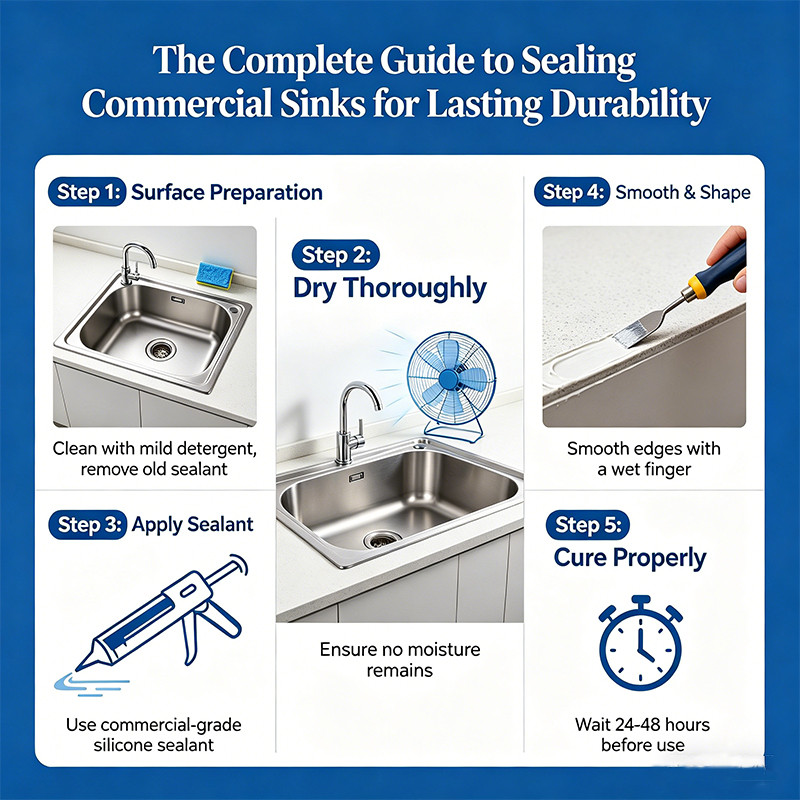
As someone who understands the high-stakes environment of a commercial kitchen, I know that a seemingly minor issue like a leaky sink can quickly escalate. It's not just an annoyance; it's a direct threat to hygiene standards, a precursor to expensive water damage repairs, and a cause of frustrating operational downtime. That's why mastering the art of sealing your commercial sinks isn't just a maintenance task—it's an essential strategy for ensuring long-term durability and regulatory compliance. Top-tier brands like Samsink design their products for longevity, but proper installation and sealing are what truly unlock their maximum potential.
In this comprehensive guide, we will dive deep into the world of sealing materials, with a sharp focus on the two most common choices: plumber's putty and silicone sealant. My objective is to provide you with the expert knowledge needed to make informed decisions. You'll learn precisely when, where, and how to use these products to guarantee your commercial sinks remain perfectly watertight, functional, and reliable for years to come.
Key Takeaways
- Sealant Choice is Crucial: The decision between plumber's putty and silicone sealant is not arbitrary. It depends entirely on the specific application, the materials of your sink, and the type of joint being sealed. Using the wrong product can lead to leaks and material damage.
- Plumber's Putty for Compression Seals: Plumber's putty is a non-adhesive, pliable substance ideal for creating a watertight but reversible seal in low-pressure compression joints, such as under sink drains and flanges. It remains soft, making future repairs easier.
- Silicone for Adhesion and Flexibility: Silicone sealant acts as both a sealant and an adhesive, creating a strong, flexible, and waterproof bond. It is essential for sealing gaps where movement or high pressure is expected, like around sink perimeters, and for bonding undermount sinks to countertops.
- Material Compatibility Matters: Standard plumber's putty can stain porous materials like granite, marble, and some plastics. Always use a stain-free putty for these surfaces. Silicone is generally safer for a wider range of materials but check manufacturer recommendations.
- Proper Application is Non-Negotiable: Achieving a lasting seal requires meticulous surface preparation, including cleaning and drying the area completely. Following step-by-step application and curing guidelines is essential for both putty and silicone to perform effectively.
- Know When NOT to Use Putty: Never use plumber's putty on pressurized water connections or threaded pipes where a thread sealant (like pipe dope or tape) is required. Its inability to withstand pressure will result in certain leaks.
Understanding the Fundamentals of Sealing for Your Commercial Sink
A reliable seal is the unsung hero of a functional commercial kitchen. It works silently in the background, preventing a cascade of problems that can disrupt your entire operation. Before we delve into the "how," it's critical to understand the "why" and get acquainted with the primary tools for the job.
Why a Watertight Commercial Sink is Non-Negotiable
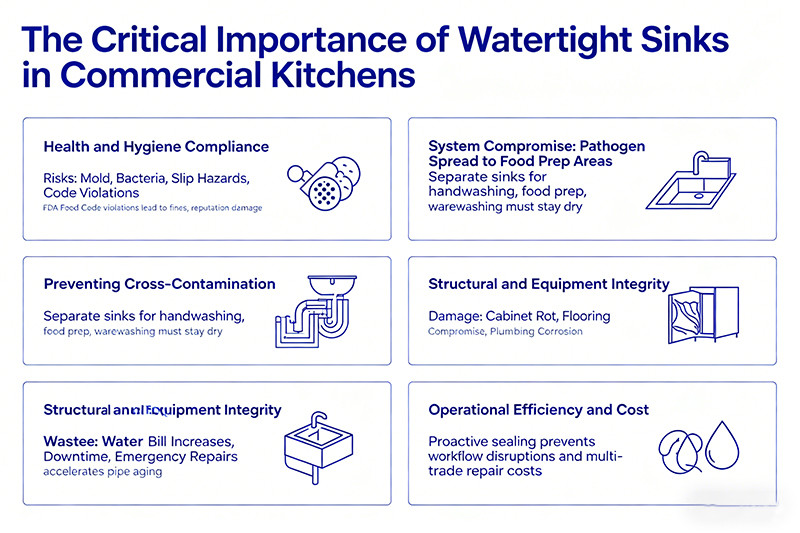
In a commercial kitchen, a watertight sink is the bedrock of sanitation, safety, and operational integrity. A leak, no matter how small, is a ticking time bomb that can trigger a cascade of serious issues. Understanding these risks underscores the importance of a perfect seal.
Health and Hygiene Compliance: Health codes, like the FDA Food Code, are incredibly strict about kitchen anitation. A leaking sink drain creates a perpetually damp environment under the sink, which is an ideal breeding ground for mold, mildew, and harmful bacteria. This black mold can release spores that pose serious respiratory risks to your staff. Furthermore, any water pooling on the floor becomes a slip-and-fall hazard, creating significant liability for your business. Health inspectors are trained to spot these issues, and a leaking sink is a clear violation that can lead to fines, forced closures, and a damaged reputation.
Preventing Cross-Contamination: Commercial kitchens rely on a system of specialized sinks—including separate units for handwashing, food preparation, and warewashing—to prevent cross-contamination. Leaks can compromise this system. For instance, if contaminated water from a warewashing sink seeps near a food prep area, it can introduce pathogens to fresh ingredients, increasing the risk of foodborne illness. Maintaining distinct, dry zones around each sink is critical for food safety.
Structural and Equipment Integrity: Undetected leaks can cause devastating damage. Water seeping from a faulty seal will saturate and warp the wooden or composite materials of your cabinetry, leading to rot and costly replacements. Over time, this moisture can damage the flooring and even compromise the building's subfloor. Furthermore, the constant dampness accelerates corrosion and aging of plumbing components like pipes and fittings, making future failures more likely.
Operational Efficiency and Cost: A leaking sink is a source of constant waste, driving up your water bill with every drip. Beyond the utility costs, dealing with a leak means downtime. You may need to shut down a critical handwashing station or a three-compartment sink for repairs, disrupting kitchen workflow during peak hours. Proactively ensuring every connection is secure is far more cost-effective than reacting to an emergency repair, which often involves not just a plumber but also potentially a carpenter or flooring specialist.
Given these stakes, treating sink sealing as a top priority is not just good practice—it's a fundamental requirement for any professionally managed kitchen.
Introducing Your Sealing Arsenal: Plumber's Putty Basics for Commercial Sinks
Plumber's putty is a classic, time-tested sealing compound that has been a staple in the plumbing trade for decades. It is a soft, pliable, clay-like substance used to create a watertight, non-adhesive compression seal. Think of it as a deformable gasket. Its primary function is to fill the small gaps under the flanges of drains and faucets to prevent water from seeping through.
Key Properties and Composition:
- Pliability: Its defining feature is that it remains soft and malleable for a very long time, never truly hardening or curing like an adhesive. This allows it to be easily shaped by hand to fit any application.
- Non-Adhesive: Plumber's putty does not glue surfaces together. It creates a seal simply by being compressed between two rigid surfaces, like the flange of a sink strainer and the sink itself. This is a significant advantage for maintenance, as fixtures sealed with putty can be removed relatively easily in the future without damaging the sink or the part.
- Composition: Traditional plumber's putty is composed of mineral fillers like limestone and clay, mixed with oils such as fish oil or other petroleum-based hydrocarbon oils. It's this oil content that keeps it pliable but also creates compatibility issues with certain materials.
- Water Resistance: When properly compressed in a joint, it forms an excellent waterproof seal against gravity-fed water, making it ideal for drain assemblies.
In a commercial setting, you'll most often see plumber's putty used to bed sink strainers and the bases of some deck-mounted faucets. It provides a reliable, long-lasting, and easily serviceable seal for these low-pressure applications.
Introducing Your Sealing Arsenal: Silicone Sealant Essentials for Commercial Sinks
Silicone sealant is a modern, versatile, and powerful alternative to plumber’s putty, offering distinctly different properties that make it essential for a wide range of applications, especially in a demanding commercial kitchen. Unlike putty, silicone is an adhesive that cures to form a strong, flexible, and fully waterproof bond.
Key Properties and Composition:
- Adhesive and Permanent: The most significant difference is that silicone is an adhesive. It chemically bonds to surfaces, creating a very strong and permanent seal. This means it's not designed for parts you plan to disassemble regularly.
- 100% Waterproof: High-quality, 100% silicone sealants are not just water-resistant; they are completely waterproof. This makes them ideal for creating seals in areas with constant water exposure or even where water might pool, like the perimeter of a sink against a countertop.
- Flexibility and Durability: Once cured, silicone transforms into a tough, rubbery solid that remains permanently flexible. This elasticity allows it to absorb vibrations and accommodate the natural expansion and contraction of different materials due to temperature changes without cracking or shrinking. Some premium silicones have joint movement capabilities of up to 50%.
- Excellent Adhesion: It bonds exceptionally well to a vast array of materials, including non-porous surfaces like stainless steel, glass, and ceramic, as well as porous surfaces like stone and wood. This makes it the go-to choice for sealing dissimilar materials.
- Temperature and Chemical Resistance: Silicone is highly resistant to extreme temperatures, both hot and cold, without degrading. Many formulations are also resistant to mold and mildew growth, a critical feature in a hygienic kitchen environment.
For commercial sinks, silicone sealant is indispensable for sealing the gap between the rim of a drop-in sink and the countertop, securing and sealing undermount sinks, and sealing backsplashes to the wall. Some specific formulations are even NSF-certified as food-safe for use in "food zones," making them perfect for commercial kitchen applications.
Maximizing Durability: Applying Plumber's Putty to Your Commercial Sink
While silicone has its place, plumber's putty remains the superior choice for specific, non-pressurized drainage applications. Its unique, non-hardening nature makes it perfect for creating a seal that is both completely watertight and fully serviceable. Understanding where and how to use it is key to leveraging its benefits without falling into common pitfalls.
Common Commercial Sink Applications for Plumber’s Putty
Plumber's putty is specifically designed for creating watertight seals in non-pressurized drainage assemblies. Its application in a commercial kitchen is precise and targeted. Using it correctly ensures a leak-free sink that can also be easily serviced later.
The most common and appropriate uses for plumber's putty on a commercial sink are:
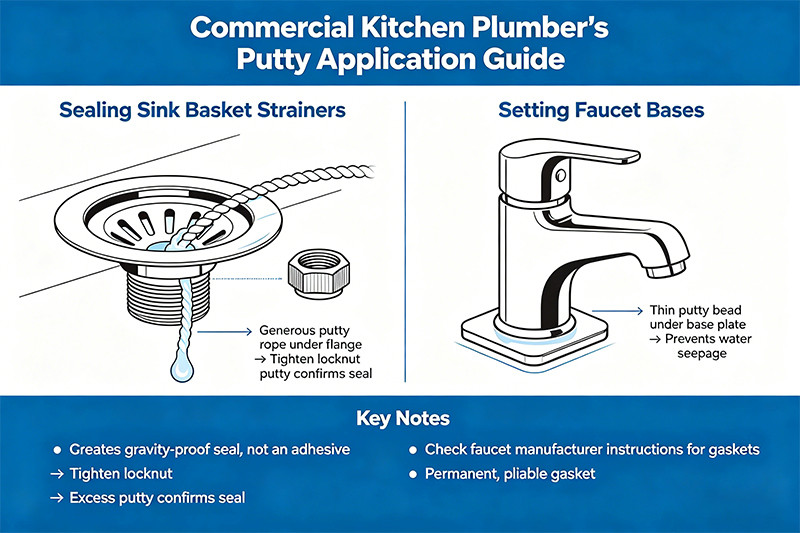
- Sealing Sink Basket Strainers: This is the quintessential application for plumber's putty. A generous rope of putty is applied to the underside of the strainer's metal flange before it's inserted into the sink's drain opening. As the locknut is tightened from below, the putty is compressed, filling any microscopic gaps between the flange and the sink surface. This creates a perfect, gravity-proof seal. The excess putty that squeezes out is a visual confirmation of a complete seal.
- Setting Faucet Bases: For some models of deck-mounted commercial faucets, a thin bead of putty can be used under the faucet's base plate. This prevents any water that splashes onto the deck of the sink from seeping underneath the faucet assembly and down into the cabinet. It acts as a gasket, sealing the joint between the faucet body and the stainless steel sink deck. However, it's crucial to check the faucet manufacturer's instructions, as many modern faucets come with pre-installed rubber or plastic gaskets that render putty unnecessary.
It is critical to remember that in both these scenarios, the putty is creating a seal against water that is flowing downwards due to gravity. It is not an adhesive and should never be used to bear weight or resist water pressure. Its value lies in its ability to form a permanent, pliable gasket that won't crack or shrink over time, which is exactly whats needed for a drain flange.
Selecting the Right Plumber's Putty for Diverse Commercial Sink Materials
Not all plumber's putty is created equal. The choice between standard, oil-based putty and a modern, stain-free an oil-free, non-staining plumbers putty. It is formulated for setting frames, faucets and basket strainers on natural surfaces including granite, marble, quartz, sandstone and other natural, porous materials. version is critically important and depends entirely on the material of your sink and the surrounding countertop. Making the wrong choice can lead to permanent damage.
1. For Non-Porous Surfaces: Stainless Steel and Porcelain
- Materials: The vast majority of commercial sinks, like those from Samsink, are made from high-quality, non-porous stainless steel. Traditional porcelain sinks are also non-porous.
- Recommended Putty: For these materials, standard, oil-based plumber's putty is perfectly acceptable and often preferred for its excellent workability and time-tested performance. The non-porous nature of stainless steel and glazed porcelain prevents the oils in the putty from being absorbed, so there is no risk of staining.
2. For Porous Surfaces: Granite, Marble, Quartz, and Composite
- Materials: High-end kitchens or bar areas might feature sinks made from granite composite, or sinks installed in natural stone countertops like granite, marble, or quartz. These materials are porous.
- Recommended Putty: For these surfaces, you must use a stain-free plumber's putty. Standard putty contains petroleum-based oils that can be drawn into the pores of the stone, creating a permanent dark stain or "shadow" around the drain flange. This damage is often irreversible. Stain-free putties are specifically formulated without these oils, making them completely safe for use on all-natural and composite porous surfaces.
3. For Plastic and Acrylic Components
- Materials: While less common for the main body of a commercial sink, some drain components or specialty sinks might be made of plastic (like PVC, ABS) or acrylic.
- Recommended Putty: It is generally advised to avoid using any type of plumber's putty on plastics. The petroleum distillates in traditional putty can soften and degrade plastic over time, potentially causing it to become brittle, warp, or fail, leading to leaks. While some stain-free putties claim to be safe for PVC, using a 100% silicone sealant is the universally recommended and safer choice for plastic components.
Product Selection Table
| Sink/Countertop Material | Recommended Sealant | Why? |
|---|---|---|
| Stainless Steel | Standard Plumber's Putty | Non-porous surface, no risk of staining. Putty provides an excellent, serviceable seal. |
| Porcelain/Ceramic | Standard Plumber's Putty | Glazed surface is non-porous and will not be stained by the oils in the putty. |
| Granite / Marble / Quartz | Stain-Free Plumber's Putty or 100% Silicone | Porous materials will absorb oil from standard putty, causing permanent stains. Stain-free putty is oil-free. |
| Composite (e.g. Silgranit) | Stain-Free Plumber's Putty or 100% Silicone | These materials are often porous and can be stained by oil-based putty. Always use a stain-free formula. |
| Plastic / Acrylic | 100% Silicone Sealant Only | Standard putty can degrade and weaken plastic over time. Silicone is chemically inert and safe. |
Before starting any job, always check the product labels on your putty and the installation instructions from the sink manufacturer. When in doubt, opting for a stain-free putty or silicone is the safest path to avoid costly damage.
Our Step-by-Step Guide to Flawless Plumber's Putty Application on Your Commercial Sink
Applying plumber's putty is a straightforward process, but precision is key to achieving a lasting, leak-proof seal. Following these steps will ensure a professional result every time, specifically for installing a basket strainer in a typical stainless steel commercial sink.
Tools & Materials You'll Need:
- Plumber's Putty: Choose the correct type for your sink material (standard for stainless steel, stain-free for porous surfaces).
- New Sink Strainer Assembly: Includes the strainer body, rubber gasket, friction ring (often cardboard), and locknut.
- Channel-lock Pliers or a Sink Drain Wrench: For tightening the locknut.
- Clean Rags or Paper Towels: For cleanup.
- Plastic Putty Knife or Scraper (optional): For removing old putty.
- Rubbing Alcohol: For final surface cleaning.
Step 1: Prepare the Surfaces for a Perfect Bond
A successful seal begins with an impeccably clean surface.
- Remove Old Material: If replacing a strainer, thoroughly remove all old putty, silicone, and grime from both the sink's drain opening and the old strainer's flange. A plastic scraper is useful here to avoid scratching the sink.
- Deep Clean: Wipe the area with a good degreasing cleaner to remove any oils or soap scum.
- Final Wipe: For the best possible result, give the sink's drain opening and the new strainer's flange a final wipe with a rag dampened with rubbing alcohol. This removes any lingering residue and ensures the surfaces are completely dry and oil-free.
Step 2: Condition and Roll the Putty
Plumber's putty works best when it is warm and pliable.
- Check Consistency: Scoop a golf-ball-sized amount of putty from its container. If it feels hard or cracks and crumbles as you work it, it's too old and should be discarded.
- Warm and Knead: Roll the putty between your palms for 30-60 seconds. The warmth from your hands will soften it, making it smooth and easy to work with.
- Form a Rope: Roll the softened putty into a uniform "rope" or "snake." Aim for a thickness of about 1/4 to 1/2 inch (roughly the thickness of a pencil). Ensure the rope is long enough to circle the entire underside of the strainer flange. Keeping the thickness consistent is key to an even seal.
Step 3: Apply the Putty Ring to the Strainer Flange
The correct placement is on the fixture, not the sink itself.
- Create a Ring: Carefully press the putty rope around the underside of the strainer's flange, forming a complete, unbroken circle. Overlap the ends slightly and pinch them together to create a continuous ring. Do not leave any gaps, as water will find a way through.
Step 4: Set the Strainer and Assemble from Below
Now you'll bring the pieces together.
- Insert the Strainer: Carefully lower the strainer straight down into the sink's drain opening. Press down firmly and evenly. You should see a small amount of putty begin to squeeze out around the edges.
- Assemble Underneath: From under the sink, slide the rubber gasket up against the bottom of the sink. Follow this with the friction ring (cardboard washer), and finally, the locknut. The friction ring is crucial—it allows the metal locknut to turn smoothly without grabbing and twisting the rubber gasket out of place.
Step 5: Tighten for Compression (But Don't Overtighten!)
This step creates the seal.
- Hand-Tighten First: Thread the locknut on by hand until it's snug.
- Use Your Wrench: Use channel-lock pliers or a dedicated sink drain wrench to tighten the locknut. While one person holds the strainer steady from above (you can insert the handles of pliers into the crossbars to prevent it from spinning), tighten the nut from below another half-turn to a full turn.
- Watch for Squeeze-Out: As you tighten, you'll see more putty squeeze out around the flange inside the sink. This is the sign of a good, compressed seal. The goal is to make it snug, not to squeeze every last bit of putty out. Over-tightening can crack a porcelain sink or damage the strainer itself.
Step 6: Clean Up and Test Your Work
The final touches ensure a professional look and a leak-free result.
- Remove Excess Putty: Use your finger, a plastic scraper, or a clean rag to neatly remove all the excess putty that has squeezed out around the drain flange. The clean putty can be returned to its container for future use.
- Leak Test: Place a bucket under the drain, plug the sink, and fill it with several inches of water. Let it sit for at least 10 minutes to give any potential slow leaks time to show up. Then, pull the plug and let the water rush out, checking carefully underneath for any drips or moisture around the new assembly. If it’s dry, your installation is a success.
Critical Considerations: When NOT to Use Plumber's Putty on Your Commercial Sink
Knowing where to use plumber’s putty is only half the battle. Just as important is knowing when not to use it. Misapplying this product can lead to guaranteed leaks, permanent stains, and damaged equipment. It is not a universal sealant, and using it in the wrong context is a recipe for failure.
Avoiding Plumber's Putty for Pressurized Commercial Sink Connections
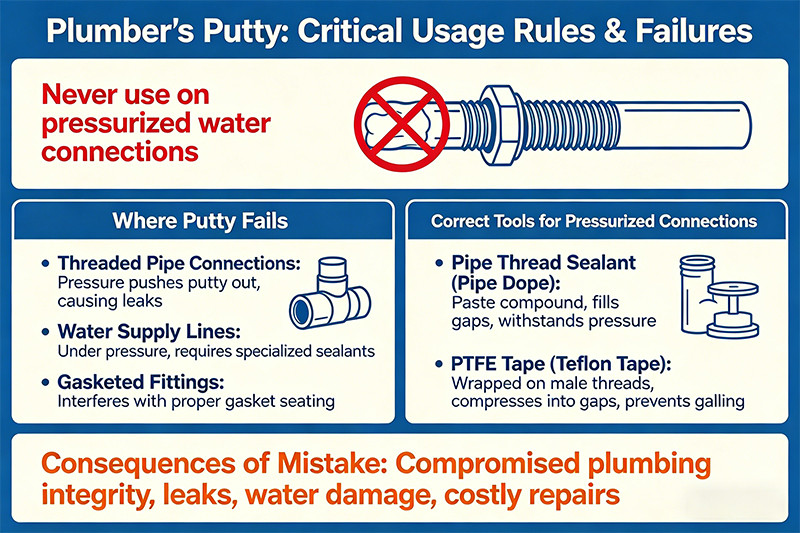
This is the single most important rule when working with plumber’s putty: never use it to seal any connection that is under water pressure. Doing so is not a shortcut; it is a guaranteed failure.
Plumber's putty is designed exclusively for compression seals on non-pressurized, gravity-fed drains. It works by being squished between two flat surfaces (like a drain flange and the sink), acting as a soft, pliable gasket. It has no adhesive properties and is not formulated to withstand any amount of sustained water pressure.
Where Putty Will Absolutely Fail:
- Threaded Pipe Connections: Using plumber's putty on the threads of water supply lines, drainpipes, or any other threaded fitting is a critical error. The pressure of the water will simply push the soft putty out of the threads, resulting in an immediate or imminent leak.
- Water Supply Lines: All connections for hot and cold water supply lines, from the angle stop at the wall to the faucet itself, are under significant pressure. These joints require specialized sealants.
- Gasketed Fittings: Any joint that is designed to be sealed with a rubber or fiber gasket should not have plumber's putty added. The putty can interfere with the proper seating of the gasket, creating a leak where none would have existed.
The Correct Tools for Pressurized Connections:
For any threaded joint, especially those on pressurized water or gas lines, you must use a proper thread sealant. The two professional standards are:
Pipe Thread Sealant (Pipe Dope): This is a paste-like compound specifically formulated to lubricate threads for tighter assembly and to fill the microscopic gaps between them, creating a durable, pressure-tight seal. It contains compounds that can withstand pressure fluctuations and temperature changes.
PTFE Tape (Teflon Tape): This thin, white tape is wrapped around the male threads of a pipe before it is screwed into a fitting. As the joint is tightened, the tape compresses into the thread gaps, creating a strong seal and also lubricating the threads to prevent galling (seizing).
Using plumber's putty where pipe dope or PTFE tape is required is a fundamental mistake that compromises the integrity of your entire plumbing system, leading to leaks, water damage, and costly emergency repairs.
Protecting Porous and Plastic Commercial Sink Surfaces: When Putty is a No-Go
While incredibly useful, plumber's putty has two major material incompatibilities that you must respect to avoid causing irreparable damage: porous surfaces and plastics. Using the wrong putty—or using it at all in some cases—is a mistake that can be costly and unsightly.
1. The Danger to Porous Surfaces (Granite, Marble, Quartz)
The oils in standard plumber's putty are its greatest weakness when it comes to porous materials.
- The Problem: Natural stones like granite and marble, as well as many man-made quartz and composite sinks, are porous. When oil-based plumber's putty is applied to these surfaces, the oils will slowly leach out of the putty and be absorbed into the material. This process, known as "bleeding", creates a dark, permanent stain or a shadowy ring around the drain or faucet.
- The Damage: This staining is often impossible to remove. Even if the putty is hidden under a flange, the stain can spread beyond the fixture's footprint over time, ruining the aesthetic of an expensive countertop or sink.
- The Solution: When working with any porous material, you have two safe options:
- Stain-Free Plumber's Putty: This is an oil-free formulation specifically designed to be safe on porous surfaces without the risk of staining. It provides the same pliable, non-adhesive seal as regular putty.
- 100% Silicone Sealant: Silicone is chemically inert and does not contain oils that can stain stone. It provides a permanent, waterproof bond and is a completely safe alternative for these materials.
2. The Threat to Plastic and Acrylic Components
Using standard plumber's putty on certain plastics is another critical mistake.
- The Problem: Traditional plumber's putty contains petroleum-based solvents. These chemicals can react with certain types of plastic, particularly ABS and acrylic. The reaction can cause the plastic to soften, become brittle, or degrade over time.
- The Damage: For a plastic drain fitting, this softening can cause it to warp under pressure or temperature changes, breaking the seal and leading to a slow, hard-to-detect leak inside your cabinet. In some cases, it can cause the plastic to crack and fail completely.
- The Solution: The safest and universally recommended sealant for any plastic plumbing component (PVC, ABS, acrylic) is 100% silicone sealant. Silicone does not react with plastic and creates a superior, permanent waterproof seal. While some drain kits for plastic sinks come with a foam or rubber gasket that replaces the need for any sealant, if a sealant is required, silicone is the only professional choice.
Ignoring these material incompatibilities can void manufacturer warranties and lead to problems that are far more expensive to fix than the cost of using the correct product in the first place.
The Power of Silicone Sealant: A Robust Solution for Your Commercial Sink
When a job requires more than just a simple compression seal, 100% silicone sealant steps in as the high-performance solution. Its unique combination of adhesion, flexibility, and absolute waterproofness makes it indispensable for several critical applications around a commercial sink where plumber’s putty would fail.
Key Advantages of Silicone for High-Demand Commercial Sink Environments
In the relentless environment of a commercial kitchen, certain sealing tasks demand performance characteristics that go far beyond what plumber's putty can offer. This is where 100% silicone sealant demonstrates its superiority. Its unique properties provide a robust and lasting solution tailored for high-demand scenarios.
1. Absolute Waterproofing and Mold Resistance Unlike putty, which is merely water-resistant, 100% silicone is completely waterproof. It creates an impenetrable barrier that prevents any moisture from seeping into gaps, which is critical for sealing the perimeter of a sink against a countertop or a backsplash against a wall. This prevents the water damage and rot that can destroy countertops and cabinetry. Furthermore, many high-quality silicone sealants are formulated with fungicides, making them resistant to mold and mildew growth—an essential feature for meeting health and safety standards in a constantly damp kitchen environment.
2. Superior Adhesion and Bonding Strength Silicone is a powerful adhesive that bonds tenaciously to a wide variety of surfaces, including stainless steel, stone, ceramic, glass, and most plastics. This adhesive quality is non-negotiable for applications like securing an undermount sink. The sealant not only creates a waterproof seal but also helps to hold the sink firmly in place, working in conjunction with mechanical clips to support its weight, especially when filled with water.
3. Permanent Flexibility and Durability Commercial kitchens experience constant vibrations from equipment and significant temperature fluctuations, from blasts of hot water to contact with cold items. Silicone cures to a flexible, rubbery state that can accommodate this movement and thermal expansion/contraction without cracking, shrinking, or pulling away from the surface. This permanent elasticity ensures the seal remains intact for years, even under the most demanding conditions, unlike more rigid sealants that would quickly fail.
4. Extreme Temperature and Chemical Resistance Silicone sealants are engineered to withstand extreme temperatures, with some formulations remaining stable from -40°F to over 400°F (-40°C to 200°C). This makes them ideal for use around sinks that handle boiling water and are subjected to high-heat sanitizing cycles. They are also highly resistant to the harsh cleaning chemicals and sanitizers used daily in commercial kitchens, ensuring the seal does not degrade or break down.
5. Food-Grade Safety and Compliance For areas in direct or potential contact with food, specialized food-grade silicone sealants are available. These products are NSF-certified (meeting standards like NSF/ANSI 51) to be non-toxic and safe for use in food zones. This ensures full compliance with health department regulations, providing peace of mind that your sealing materials are not a source of contamination.
These combined advantages make 100% silicone sealant the only professional choice for sealing sink perimeters, backsplashes, and mounting undermount sinks in a commercial setting.

Comparing Application and Curing: Silicone vs. Plumber's Putty for Your Commercial Sink
While their end goal is similar—preventing leaks—the processes of applying and curing plumber's putty and silicone sealant are fundamentally different. These differences in application ease, time investment, and cleanup have significant implications for commercial kitchen maintenance.
| Feature | Plumber's Putty | 100% Silicone Sealant |
|---|---|---|
| Application Method | Manual application. Knead by hand, roll into a rope, and apply directly to the fixture. | Applied with a caulking gun for a controlled bead. Requires more skill to apply evenly. |
| Required Tools | Hands are the primary tool. A plastic scraper for cleanup is helpful. | Caulking gun, smoothing tools, painter's tape (for clean lines), mineral spirits for cleanup. |
| Curing / Dry Time | No cure time. The fixture can be used immediately after installation and cleanup. | Requires curing time. Typically water-ready in 30 minutes to 8 hours, but requires a full 24 hours or more to cure completely. The area must remain dry during this period. |
| Removability | Easily removable. Because it's non-adhesive and stays soft, fixtures can be disassembled years later with minimal effort. Old putty scrapes off easily. | Difficult to remove. As a strong adhesive, it creates a permanent bond. Removal requires cutting, scraping, and often using chemical softeners like mineral spirits. |
| Cleanup Process | Very easy. Excess putty that squeezes out can be wiped away with a finger or a dry rag. No solvents are needed. | Can be messy. Uncured silicone is sticky and smears easily. It must be cleaned up immediately with mineral spirits. Once cured, it must be mechanically scraped or cut away. |
| Adjustability | Adjustable. Because it doesn't harden, a fixture can be slightly repositioned during installation. | Not adjustable. Once applied, the fixture cannot be moved. If a mistake is made, the silicone must be completely removed and reapplied. |
In a Commercial Kitchen Context:
- Speed: Plumber's putty offers a significant advantage for speed. When a sink drain needs to be replaced during service hours, the ability to use the sink immediately after the repair is invaluable. The 24-hour cure time for silicone would mean taking a critical sink out of commission for an entire day.
- Serviceability: Commercial sink parts, especially strainers, endure heavy use and may need replacement. Putty's easy removability makes this a quick and simple maintenance task. Removing a strainer that has been sealed with silicone can be a time-consuming and difficult job, potentially damaging the sink surface in the process.
- Skill Level: Applying putty is a more forgiving, beginner-friendly process. Laying a clean, professional-looking bead of silicone requires more practice and skill.
While silicone's strength and permanence are vital for certain applications (like undermount sinks), plumber's putty's ease of use, immediate serviceability, and simple cleanup make it the superior and more practical choice for its intended application on drain flanges.
Your Commercial Sink Sealing Questions Answered (FAQ)
Even with a comprehensive guide, specific questions always arise. Here are answers to some of the most frequently asked questions about sealing commercial sinks with plumber's putty and silicone, providing clear, expert advice to ensure you get it right every time.
Does plumber's putty ever harden when used on a commercial sink?
No, plumber's putty is specifically designed not to harden. Its primary advantage is that it remains a soft, pliable, clay-like compound indefinitely when used in its intended application (compressed between two rigid, non-porous surfaces).
This non-hardening property is crucial for two reasons:
- Durable Seal: It allows the putty to accommodate micro-vibrations and slight movements without cracking, maintaining a continuous watertight seal over many years. A material that hardens would become brittle and could develop cracks, leading to leaks.
- Serviceability: Because it stays soft, fixtures sealed with putty, like a sink strainer, can be easily removed for cleaning or replacement years down the line. The old putty can be scraped away cleanly without a struggle.
While plumber's putty does not harden in the joint, it will dry out and become hard and crumbly if the container is left open and exposed to air for an extended period. If the putty in your tub is hard or cracks when you try to roll it, it is no longer usable and must be discarded.
Can I use standard plumber's putty on all plastic commercial sink parts?
No, you should never use standard, oil-based plumber's putty on plastic parts. This is a critical rule that, if ignored, can lead to component failure and leaks.
The petroleum distillates and oils found in traditional plumber's putty are chemically incompatible with many common plastics, including ABS (the rigid, black plastic often used for drainpipes) and acrylic. The oils can cause the plastic to become brittle, soften, or degrade over time. This chemical reaction weakens the plastic, making it prone to cracking or warping, which will inevitably compromise the seal.
Are there any exceptions?
- Stain-Free (Oil-Free) Putty: Some newer, oil-free "stain-free" plumber's putties are marketed as being compatible with ABS and PVC. One specific reformulated product from Oatey is now rated as safe for ABS connections. However, you must read the product label carefully. Do not assume any stain-free putty is safe for all plastics.
- Manufacturer Gaskets: Many modern plastic drain assemblies are designed to be installed without any putty or sealant at all. They often come with a high-quality foam or rubber gasket that creates the seal on its own. Using putty in this case can interfere with the gasket and cause a leak.
The Safest and Most Professional Choice for Plastic:
For any plastic sink or drain component, the universally recommended and safest sealant is 100% silicone.
Silicone is chemically inert and will not react with or damage plastic. It creates a strong, flexible, and completely waterproof bond that is far superior to what putty could provide on a plastic surface.
In summary: Unless the putty manufacturer explicitly states on the container that it is safe for the specific type of plastic you are using (e.g., ABS), do not use it. When in doubt, always default to using 100% silicone sealant for any plastic plumbing parts.
How long do I wait for plumber's putty to dry on my commercial sink before use?
One of the most significant advantages of using plumber's putty is that there is no drying or curing time required.
You can use your commercial sink immediately after the installation is complete and the excess putty has been cleaned up.
Here's why:
- It's a Compression Sealant, Not an Adhesive: Plumber's putty does not "dry" or "cure" in the same way that silicone or an epoxy does. It is not an adhesive that needs to harden to create a bond.
- The Seal is Mechanical: The watertight seal is created instantly by the mechanical pressure of tightening the drain's locknut. This compression forces the soft, pliable putty into all the microscopic gaps between the drain flange and the sink surface, creating a physical barrier against water.
This feature is a major benefit in a fast-paced commercial kitchen. If a drain needs to be repaired or replaced, the work can be done and the sink can be put back into service without any downtime, which is crucial for maintaining operational workflow.
The only exception is if you are working in extremely cold conditions, where it is sometimes recommended to wait about 10 minutes before use to allow the cold putty to fully settle into place. However, in a typical indoor kitchen environment, no waiting is necessary.
Is plumber's putty truly waterproof for a commercial sink outlet?
Yes, plumber's putty creates a truly waterproof seal for its intended application, which is on a non-pressurized commercial sink outlet (drain).
It's important to differentiate between "waterproof" and "water-resistant."
- Waterproof: 100% silicone sealant is truly waterproof. It forms an adhesive, non-porous barrier that can withstand constant water exposure and pressure without failing.
- Water-Resistant: Plumber's putty is water-resistant. It is an oil-based compound that repels water very effectively. When it is compressed between the flange of the drain and the sink surface, it creates a mechanical seal that is impermeable to water flowing down the drain under the force of gravity.
How it Creates a Waterproof Seal for the Application:
The seal is not based on the putty's own inherent waterproof nature but on how it's used:
- Fills Gaps: It is forced into every microscopic imperfection and gap between the two rigid surfaces.
- Compression: The pressure from tightening the locknut compresses the putty, leaving no path for water to travel.
- Remains Pliable: Because it never hardens, it continues to fill the gap even with minor shifts or vibrations, maintaining the integrity of the seal for years.
The Crucial Limitation:
While it creates a perfect seal for a sink drain, plumber’s putty is NOT waterproof under pressure. If used on a pressurized water line or submerged continuously, the water pressure will eventually work its way through the soft putty, causing a leak.
So, for a commercial sink outlet, the seal created by plumber's putty is absolutely effective and considered waterproof for that specific job. It will reliably prevent water from leaking from inside the sink into the cabinet below.
What's the best way to remove old plumber's putty from my commercial sink?
Removing old plumber's putty is generally a straightforward process, especially since the material is designed not to be a permanent adhesive. The exact method depends on whether the putty is still relatively soft or has become hardened and brittle over time.
Tools You'll Need:
- Plastic Putty Knife or Scraper: A plastic tool is essential to avoid scratching your stainless steel or porcelain sink.
- Utility Knife (optional): For carefully scoring very hard putty.
- Clean Rags or Paper Towels
- Mineral Spirits or Rubbing Alcohol
- Heat Gun or Hair Dryer (for very stubborn cases)
Method 1: For Soft or Pliable Putty
This is the most common scenario. Because putty doesn't harden in a properly sealed joint, the old putty should still be soft.
- Disassemble the Fixture: First, disconnect the plumbing and remove the sink strainer or faucet that the putty is sealing.
- Scrape Away the Bulk: Use a plastic putty knife to get under the edge of the putty and lift it off in large pieces. It should peel away from the metal or porcelain surface quite easily.
- Wipe the Residue: Use a dry rag to wipe away any remaining small bits and the oily residue left behind. For a perfectly clean surface, finish by wiping the area with a rag lightly dampened with mineral spirits or rubbing alcohol.
Method 2: For Hardened or Brittle Putty
If putty was exposed to air or is very old, it may have become hard.
- Gently Pry and Chip: Use the edge of your plastic putty knife to gently chip away at the hardened putty. Be careful not to apply too much force, which could damage the sink's finish. Often, the hardened putty will break off in chunks.
- Apply Gentle Heat (If Needed): If the putty is rock-hard and won't budge, you can use a hairdryer or a heat gun on a low setting to gently warm the area for 30-60 seconds. This will often soften the old oils just enough to make scraping easier. Be very careful not to overheat the area, especially on porcelain sinks.
- Dissolve the Final Residue: After scraping away all the solid pieces, a stubborn film will likely remain. This is where a solvent is most effective. Dampen a clean cloth with mineral spirits and wipe the area vigorously. Mineral spirits are excellent at dissolving the old, dried oils that bind the putty.
- Final Clean: Once the residue is gone, clean the area with soap and water to remove any leftover solvent, and then dry it completely before applying new putty or sealant.
Pro-Tip for Stainless Steel: After cleaning the putty residue off a stainless steel sink, you can restore its uniform shine by cleaning the entire sink basin with a mild abrasive cleaner like baking soda or a specialized stainless steel cleaner, always scrubbing in the direction of the grain to avoid scratches.
Conclusion
By now, you are well-equipped with the professional knowledge to distinguish between plumber's putty and silicone sealant and to use each with confidence. You understand that plumber's putty is the go-to, serviceable solution for non-pressurized drain assemblies, while 100% silicone sealant provides a permanent, adhesive, and flexible waterproof bond for perimeters, undermounts, and plastic components. Understanding these unique properties and correct applications empowers you to ensure every commercial sink in your facility is sealed effectively and built for durability. This proactive approach to installation and maintenance will undoubtedly save you significant time, money, and operational headaches in the long run.
I strongly encourage you to take these insights and apply them directly to your commercial kitchen operations. A properly sealed commercial sink from a quality brand like Samsink is a foundational element of an efficient, safe, and hygienic workspace. It reflects a commitment to quality that extends from your equipment to the service you provide. Take a moment to inspect your current sink seals. Are they holding up? Do you see signs of failure or improper material use? Applying the right sealant today is a small investment that protects the longevity of your equipment and the integrity of your business for years to come.